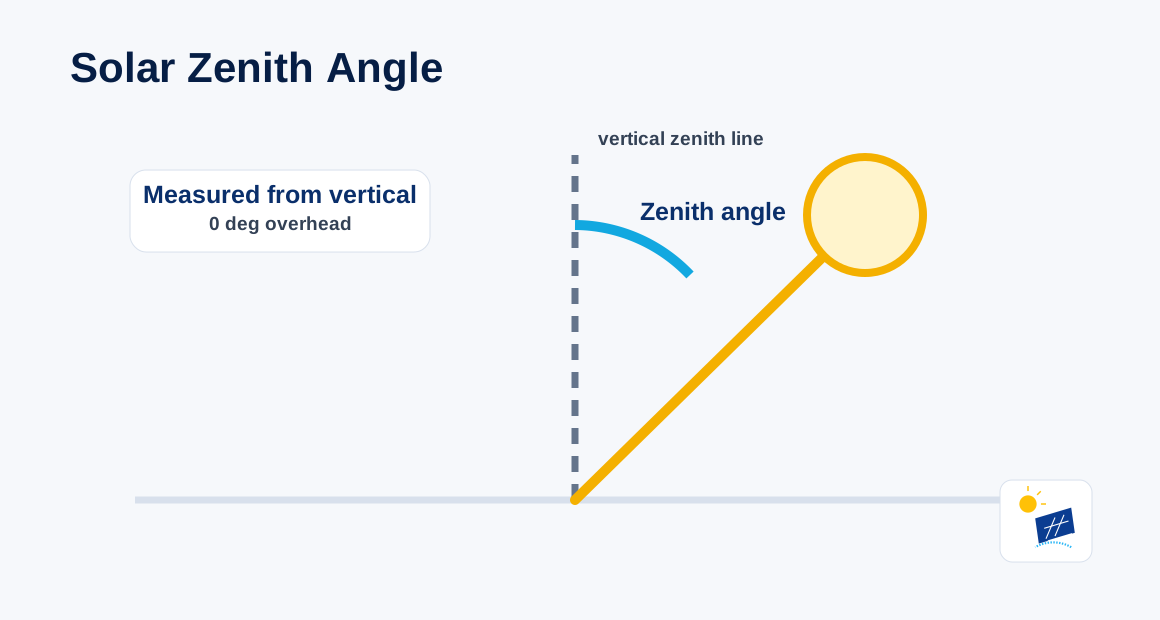
What is solar zenith angle?
Solar zenith angle measures the sun's distance from the local vertical line. The local vertical line is the point straight overhead from the observer's position.
Solar zenith belongs to the sun-position system. NREL's Solar Position Algorithm calculates solar zenith and solar azimuth for solar radiation applications. NOAA Solar Calculator also provides solar position from location, date, and time.
Solar zenith differs from panel tilt. Panel tilt measures the module surface from horizontal. Zenith measures the sun from overhead. A solar panel angle calculator uses panel tilt as a surface input and uses solar-position logic to interpret how sunlight reaches that surface.
How Do You Calculate the Solar Zenith Angle for Your Location?
Enter a latitude, date, and hour to calculate the solar zenith angle with the formula from this page. The widget computes declination for the date, the hour angle for the time, and returns the zenith angle live.
How is solar zenith angle related to solar elevation?
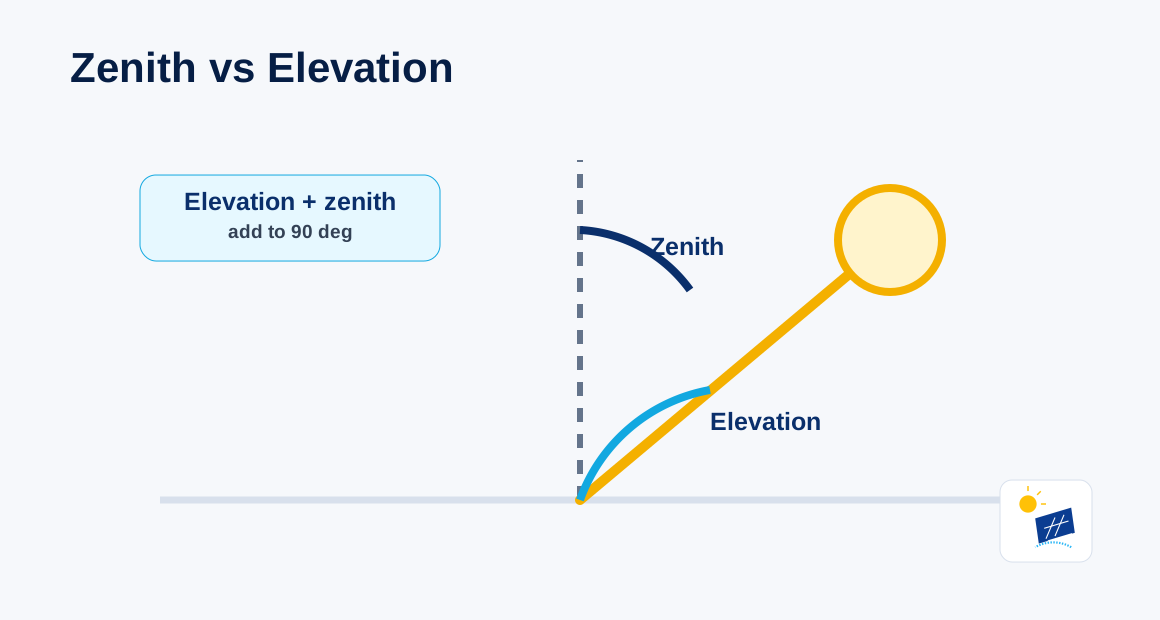
Solar zenith and solar elevation describe the same vertical sun position from opposite references. Solar elevation starts at the horizon; solar zenith starts overhead.
The relationship is simple:
| Solar value | Reference point | Meaning |
|---|---|---|
| Solar elevation | horizon | sun height above horizon |
| Solar zenith | overhead point | sun distance from vertical |
| Relationship | same vertical geometry | elevation + zenith = 90 deg |
A 30 deg Solar Elevation Angle equals a 60 deg solar zenith. A 70 deg solar elevation equals a 20 deg solar zenith. At sunrise or sunset, solar elevation is near 0 deg and solar zenith is near 90 deg. Near the highest daily sun position, elevation is higher and zenith is lower.
Why does solar zenith angle matter for solar panels?
Solar zenith matters for solar panels because it describes how high or low the sun sits relative to the local sky. That height changes shadow length and sunlight angle.
Low zenith values describe a high sun. High sun creates shorter shadows and changes how directly sunlight reaches a panel surface. High zenith values describe a low sun. Low sun creates longer shadows and increases the importance of roof obstructions, nearby trees, chimneys, parapets, and terrain.
Zenith also links sun position to plane-of-array irradiance. PVWatts reports plane-of-array irradiance as an output field for modeled systems. That output depends on the panel surface and the solar resource data, but the physical concept starts with where the sun sits in the sky.
How does solar zenith angle change through the day?
Solar zenith changes through the day as the sun rises, reaches its highest daily position near solar noon, and moves toward sunset.
Morning zenith is high because the sun is closer to the horizon. Near solar noon, zenith reaches its daily low point because the sun is highest. Afternoon zenith rises again as the sun moves toward the western horizon.
This daily pattern explains why shade checks require time context. A roof can be clear near solar noon but shaded in the morning or afternoon. A tree east of the array matters more during the morning. A western ridge matters more during the afternoon. Zenith controls shadow length during each of those periods.
How does solar zenith angle change by season?
Solar zenith changes by season because Earth's axial tilt changes the apparent height of the sun through the year. Summer generally has lower zenith values than winter at many mid-latitude sites.
NASA explains seasons through Earth's tilt and hemisphere geometry. For solar planning, that broad geometry appears as a changing sun height. In summer, solar elevation is higher and zenith is lower. In winter, solar elevation is lower and zenith is higher.
Winter zenith is the stricter shade condition. Longer winter shadows reveal obstructions that summer checks miss. A roof with acceptable summer exposure can lose winter exposure when the sun stays low. A seasonal tilt rule also follows this geometry: lower summer panel tilt and steeper winter panel tilt match the changing sun height.
How does latitude change solar zenith angle?
Latitude changes solar zenith because the same date and time produce different sun heights at different locations.
A lower-latitude location often sees the sun higher in the sky than a higher-latitude location. That means the same roof pitch and panel direction can interact with different zenith patterns in Florida, Oregon, Minnesota, or Arizona. Latitude is one reason ZIP-code and latitude calculators produce location-specific angle results.
PVWatts requires latitude and longitude when a specific weather file is not supplied. That requirement reflects the solar-resource and geometry dependency. A panel angle is not only a hardware choice. It is a local-sky choice.
How is solar zenith angle used in incidence angle?
Solar zenith helps calculate incidence angle because incidence angle measures how sunlight meets a tilted panel surface.
Solar zenith describes the sun's vertical position. Solar azimuth describes the sun's horizontal direction. Panel tilt and panel azimuth describe the module surface. Solar Incidence Angle combines those relationships into the angle between incoming sunlight and the panel's perpendicular line.
NREL's Solar Position Algorithm includes incidence-angle calculation for a surface with slope and rotation. That is why zenith matters in technical solar geometry even when a homeowner reads elevation more easily. Zenith is one part of the mathematical path from sun position to panel-surface alignment.
How does solar zenith angle affect roof shade?
Solar zenith affects roof shade because zenith controls how close the sun is to the horizon or overhead point.
High zenith means the sun is low. Low sun creates long shadows from objects that sit between the sun and the array. Trees, roof ridges, chimneys, dormers, vents, parapets, hills, and neighboring buildings become more important when zenith rises. A winter roof inspection often reveals shade that a summer inspection misses.
Low zenith means the sun is high. High sun creates shorter shadows, but short shadows do not remove shade risk. A vent or chimney near a panel row can still cast a local shadow when the sun path crosses the obstruction. Zenith only describes vertical sun height; azimuth still describes the direction of the shadow.
How does solar zenith angle affect flat roofs and ground mounts?
Solar zenith affects flat roofs and ground mounts by changing row-to-row shading and useful rack angle through the year.
Flat roofs often use racking to set the panel tilt. Ground mounts also set tilt and direction independently from a roof plane. When zenith is high in winter, low sun creates longer shadows behind rows. Row spacing must account for that low-sun condition so one row does not shade the row behind it.
Summer zenith creates a different design condition. Higher sun reduces row-shadow length, but summer is not the only season that matters for a year-round fixed array. A layout that only responds to high summer sun can understate winter shade risk. Zenith gives the vertical geometry behind row spacing, tilt, and obstruction distance.
What values are confused with solar zenith angle?
Solar zenith is commonly confused with solar elevation, panel tilt, roof pitch, and incidence angle.
Solar elevation is the opposite vertical reference. Panel tilt is the module slope from horizontal. Roof Pitch is the roof slope, often converted from a rise-over-run ratio into degrees. Incidence angle is the angle between sunlight and the panel's perpendicular line.
The same degree number can appear in different fields with different meanings. A 30 deg roof pitch, a 30 deg solar elevation, a 30 deg panel tilt, and a 30 deg incidence angle describe four different relationships. A solar calculator stays accurate only when each value is entered into the correct field.
What mistakes distort solar zenith angle interpretation?
Solar zenith mistakes include confusing zenith with elevation, treating zenith as panel tilt, and ignoring the date and time attached to the value.
Zenith and elevation move in opposite directions. A higher elevation means a lower zenith. A lower elevation means a higher zenith. Mixing those values can reverse the meaning of a solar-position result.
Panel tilt is another common confusion. A 35 deg panel tilt does not mean a 35 deg solar zenith. Tilt belongs to the panel surface. Zenith belongs to the sun. A calculator result stays useful only when each angle remains attached to the correct entity.
How do you use solar zenith angle for solar planning?
Use solar zenith to understand sun height, seasonal shade risk, and the relationship between sun position and panel-surface alignment.
A practical workflow starts with location, date, and time. Read the sun's zenith or elevation. Compare the value with roof pitch, panel tilt, direction, and shade objects. Repeat the check for morning, solar noon, afternoon, summer, and winter.
Solar zenith is not a standalone installation answer. The final surface decision also needs panel azimuth, roof pitch, mount type, shade timing, roof condition, and site review. Zenith gives the vertical sun-position layer inside that larger decision.
How Do You Calculate the Zenith Angle Step by Step?
The zenith angle is calculated in 3 steps: find the latitude, find the solar declination for the date, then apply the formula zenith angle equals 90 degrees minus latitude plus declination. At 40.7 degrees north on the June solstice, declination runs plus 23.44 degrees, so the noon zenith angle equals 90 minus 40.7 plus 23.44, which equals 72.7 degrees from vertical. The same location on the December solstice runs 90 minus 40.7 minus 23.44, which equals 26.0 degrees, the highest zenith angle of the year.
The worked values for 3 latitudes at both solstices:
| Location | Latitude | June solstice | December solstice |
|---|---|---|---|
| Miami | 25.8°N | 12.4° | 59.2° |
| New York | 40.7°N | 25.9° | 72.7° |
| London | 51.5°N | 38.1° | 84.9° |
The solar elevation angle is the zenith angle's complement: elevation equals 90 degrees minus the zenith angle. A 25.9 degree zenith in New York in June means the sun sits 64.1 degrees above the horizon, and the Solar Elevation Angle page carries that half of the position pair.
What Is the Difference Between Zenith Angle and Altitude Angle?
The difference between zenith angle and altitude angle is the reference they measure from: the zenith angle counts down from the point directly overhead, and the altitude angle counts up from the horizon. The two angles always sum to 90 degrees. A sun at 30 degrees zenith sits at 60 degrees altitude, and a sun at the zenith point itself runs 0 degrees zenith and 90 degrees altitude.
Solar engineering uses both conventions. Radiation and atmosphere work references the zenith angle because air mass depends on the path from overhead. Panel and shading work references the altitude angle because shadows and mount heights measure from the ground. The Solar Panel Angle Calculator reports panel tilt against the horizontal plane, the same reference as altitude.
What Is the Solar Zenith Angle Formula?
The solar zenith angle formula calculates the sun's zenith angle from latitude, declination, and hour angle: cos of the solar zenith angle equals sin of latitude times sin of declination plus cos of latitude times cos of declination times cos of the hour angle. The formula uses the symbol theta s for the solar zenith angle, phi for latitude, delta for declination, and h for the hour angle.
| Symbol | Variable | Meaning |
|---|---|---|
| θs | Solar zenith angle | Degrees from the vertical point directly overhead |
| φ | Latitude | Degrees north or south of the equator |
| δ | Declination | Angle between the sun's rays and the equatorial plane, plus 23.44 to minus 23.44 degrees through the year |
| h | Hour angle | Zero at solar noon, 15 degrees per hour from solar noon, negative in the morning and positive in the afternoon |
cos θs = sin φ sin δ + cos φ cos δ cos h
At solar noon the hour angle h equals zero, so cos of h equals 1 and the formula simplifies: the solar zenith angle equals the absolute value of latitude minus declination. At 40.7 degrees north on the June solstice, declination runs plus 23.44 degrees, so the noon solar zenith angle equals 40.7 minus 23.44, which is 17.3 degrees from vertical. The same location on the December solstice runs 40.7 plus 23.44, which is 64.1 degrees. The full formula with the hour angle gives the sun's zenith angle at any hour of the day, not only noon.
When Is the Solar Zenith Angle at Its Minimum and Maximum?
The solar zenith angle reaches its daily minimum at local solar noon, when the hour angle equals zero and the sun stands highest in the sky. The minimum equals the absolute value of latitude minus declination. The sun's zenith angle reaches its daily maximum at local midnight, when the hour angle runs 180 degrees and the sun sits lowest below the horizon on the opposite side of the Earth.
Two boundary conditions extend the range. When the minimum solar zenith angle would exceed 90 degrees, the sun never rises: the location is in polar night. When the maximum stays under 90 degrees, the sun never sets: the location is in polar day. Both conditions occur only above about 66.5 degrees latitude in their respective winters and summers. At locations outside the polar circles the sun's zenith angle passes through 90 degrees at sunrise and sunset, and after sunset the solar zenith angle technically exceeds 90 degrees and the value is undefined for solar work because no sunlight reaches the panel plane.
What Is the Sun's Zenith Angle?
The sun's zenith angle is the same measurement as the solar zenith angle: the angle between the sun's rays and the vertical direction straight overhead. Phrasing differs by field. Astronomy and atmospheric science write solar zenith angle and often abbreviate it SZA. Satellite remote sensing adds the viewing zenith angle, the matching angle measured toward the satellite instead of the sun. Solar panel planning writes the sun's zenith angle, the zenith angle of the sun, or simply the zenith angle, and all of the phrasings describe one geometric fact: zero degrees when the sun passes directly overhead and growing toward 90 degrees as the sun approaches the horizon.
The sun zenith angle pairs with the azimuth angle to fix the sun's full position in the sky: the zenith or elevation angle gives the height, and the azimuth gives the compass direction. The Solar Azimuth Angle page carries the horizontal half of that pair, and the Sun Position Calculator returns both values for any location and time.
Sources: NOAA Solar Calculator · NASA POWER Solar Data