What is solar declination?
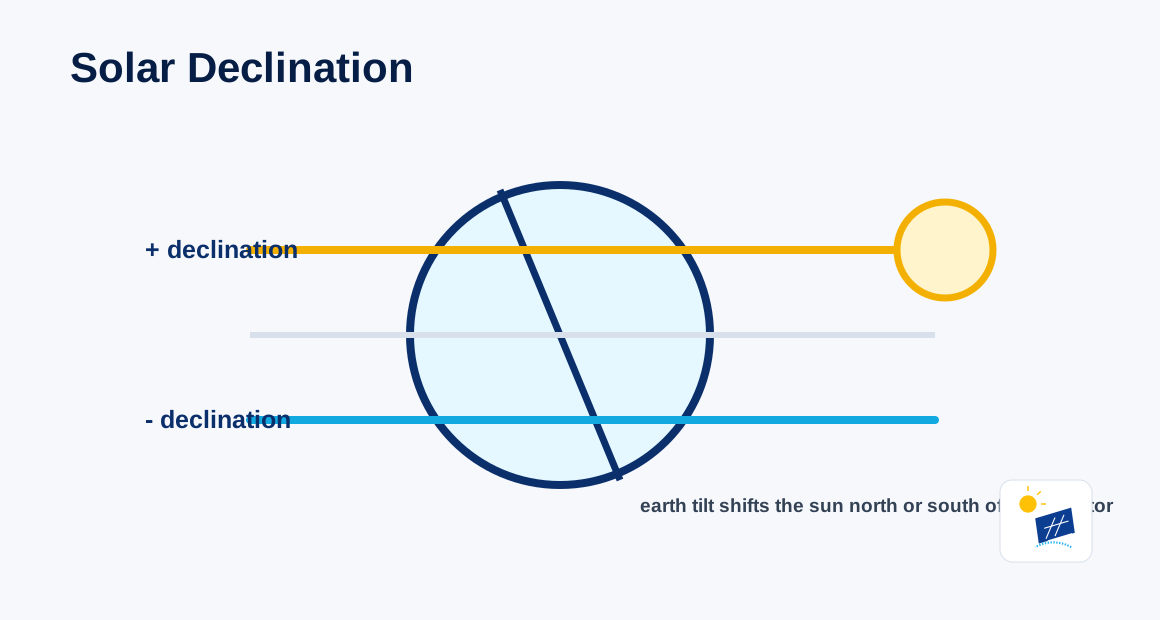
Solar declination describes the sun's apparent angular position north or south of Earth's equator.
Solar declination is a sky-geometry value. Around the June solstice, the sun's apparent position is farthest north. Around the December solstice, the sun's apparent position is farthest south. Around the equinoxes, the sun's apparent position is near the equator.
NASA explains seasons through Earth's axial tilt and the changing sunlight geometry received by each hemisphere. Declination is one way solar geometry expresses that seasonal shift. Solar panel planning uses the same seasonal shift when interpreting summer and winter tilt.
Why does solar declination matter for solar panels?
Solar declination matters for solar panels because it changes the sun path, solar elevation, shade length, and seasonal tilt baseline.
Panel angle rules often look simple because they hide declination inside seasonal adjustment. A fixed annual tilt starts near latitude under common site methodology. Summer tilt uses a lower angle because the sun is higher. Winter tilt uses a steeper angle because the sun is lower.
Declination also explains why the same roof performs differently across the year. A roof pitch that aligns reasonably with summer sun can be weaker for winter sun. A shade object that misses the array during high-sun months can cross the panels when declination shifts the path lower.

How does solar declination change through the year?
Solar declination changes gradually through the year as Earth's tilted axis changes the sun's apparent north-south position.
The yearly pattern has three anchor states:
| Seasonal point | Declination meaning | Solar panel relevance |
|---|---|---|
| June solstice | sun appears farthest north | higher Northern Hemisphere sun path |
| Equinox | sun appears near equator | transition between seasonal paths |
| December solstice | sun appears farthest south | lower Northern Hemisphere sun path |
The hemisphere changes the interpretation. June produces higher sun paths for many Northern Hemisphere locations and lower seasonal context for many Southern Hemisphere locations. December reverses that pattern. A global calculator needs hemisphere awareness because declination interacts with latitude.
How does declination connect to latitude?
Declination connects to latitude because the sun's noon height depends on the distance between the observer's latitude and the sun's declination.
At solar noon, the sun reaches its highest daily position. The closer solar declination is to the site's latitude, the higher the sun appears at noon. The farther declination is from the site's latitude, the lower the noon sun appears.
This relationship explains why latitude-based tilt rules work as educational baselines. A panel near the equator-side reference direction responds to the seasonal difference between site latitude and sun declination. PVWatts requires latitude and longitude when a specific climate file is not supplied, which reflects the location dependency of solar modeling.
How does declination affect summer panel angle?
Declination affects summer panel angle by raising the sun path in the local summer hemisphere. Higher sun paths favor lower seasonal panel tilt.
In the Northern Hemisphere, solar declination shifts northward toward the June solstice. That shift raises the midday sun path for many locations. A lower summer tilt baseline follows that higher path because the panel surface leans less steeply toward the horizon-side sun.
The simplified summer method uses latitude minus an adjustment. That rule is not an engineering command. Roof pitch, flush mounting, wind exposure, racking limits, shade, and structural conditions still define the practical installation surface.
How does declination affect winter panel angle?
Declination affects winter panel angle by lowering the sun path in the local winter hemisphere. Lower sun paths favor steeper seasonal panel tilt.
In the Northern Hemisphere, solar declination shifts southward toward the December solstice. The sun sits lower in the southern sky. A steeper winter tilt baseline follows that lower path because the panel face leans more toward the low winter sun.
Winter declination also increases shade risk. Low solar elevation creates longer shadows from trees, hills, roof ridges, chimneys, vents, parapets, and neighboring buildings. Winter evaluation is often the strictest roof-shade check.
How does declination differ from solar elevation and zenith?
Declination describes the sun's north-south position relative to Earth's equator, while elevation and zenith describe the sun's height in the local sky.
Declination is global for a date. Solar elevation and zenith are local for a location and time. The same declination value creates different solar elevations at different latitudes and different times of day.
Solar Elevation Angle is the sun's height above the horizon. Solar Zenith Angle is the sun's distance from overhead. Declination helps calculate those local values, but it is not the same kind of angle. A user reading a solar calculator result needs to keep the reference frame attached to the value.
How does declination affect shade?
Declination affects shade by changing the seasonal height and path of the sun. Lower seasonal paths create longer shadows.
Winter shade is the main practical example. A tree that sits outside the summer sun path can cross the winter sun path. A roof obstruction that casts a short summer shadow can cast a longer winter shadow. A ground-mount row spacing plan also needs winter path awareness because low sun creates row-to-row shade risk.
DOE Energy Saver guidance identifies sunlight reaching the site as a solar planning factor. Declination explains why that sunlight access changes through the year rather than staying fixed.
How does declination affect solar noon height?
Solar declination affects solar noon height because noon sun height depends on the angular difference between site latitude and the sun's declination.
Solar noon is the highest daily sun position. When the sun's declination sits closer to the site's latitude, the noon sun is higher. When the declination sits farther from the site's latitude, the noon sun is lower. This relationship explains why the noon sun changes so much between summer and winter at mid-latitude sites.
The same declination value creates different local outcomes. A June declination can put the sun very high at a lower-latitude Northern Hemisphere site, while a higher-latitude site still sees a lower maximum height. Latitude remains the local filter for the global declination value.
How does declination connect to solstice and equinox searches?
Solar declination connects solstice and equinox searches to solar-panel angle because solstices mark seasonal extremes and equinoxes mark transition points.
The June solstice and December solstice represent the farthest seasonal declination positions. Those days frame the high-sun and low-sun extremes for many locations. Equinox days sit near the middle of that annual swing, when the sun's apparent position is closer to Earth's equator.
Solar panel angle rules use the same seasonal logic. Summer Solar Panel Angle targets the high-sun side of the year. Winter Solar Panel Angle targets the low-sun side. Fixed annual tilt sits between those conditions as a compromise. Declination is the underlying seasonal entity behind all three.
How does declination affect north and south orientation?
Solar declination affects north and south orientation by shifting the sun path between hemispheres through the year.
Northern Hemisphere fixed panels generally use true south as the main reference because the strongest daily arc sits toward the southern sky for many sites. Southern Hemisphere fixed panels generally use true north. Declination changes the height and exact path of that arc through the seasons.
Near the tropics, declination creates more complex sun-path behavior because the sun can pass high overhead at certain times of year. In higher latitudes, the equator-facing reference remains easier to interpret. A global solar calculator needs latitude and hemisphere before turning declination into a panel-angle result.
What mistakes distort solar declination?
Solar declination mistakes include treating declination as panel tilt, ignoring hemisphere, and using one seasonal rule for every roof surface.
Declination is not the installed panel angle. A declination value describes the sun's apparent position. A panel tilt value describes a module surface. A roof pitch describes a roof slope. Those three values connect, but they are not interchangeable.
Hemisphere is another common error. A June seasonal rule for a Northern Hemisphere site does not describe the same seasonal condition in the Southern Hemisphere. Declination requires hemisphere context because Earth's tilt creates opposite seasonal geometry.
How do you use declination in solar planning?
Use solar declination to understand why solar panel angle changes by season and why latitude matters in tilt calculations.
A practical planning flow starts with location, latitude, and season. The season sets declination context. Latitude sets local sky context. Roof pitch and azimuth set the panel surface. Shade analysis verifies whether the seasonal sun path reaches the surface.
Declination is mainly an explanation layer for most homeowners. A calculator usually handles the math. The user-facing value is the recommended tilt, sun position, or orientation result that comes from the location and season.
Sources: NOAA Solar Calculator · NASA POWER Solar Data