
What is the best summer solar panel angle?
The best summer solar panel angle is latitude - 15 deg for adjustable mounts. The result is measured from horizontal and limited at 0 deg when the formula produces a negative value.
Summer solar panel angle is a seasonal tilt target. It is not the same as annual fixed tilt. Fixed tilt serves the full year. Summer tilt prioritizes the high-sun months.
What is the summer tilt formula?
The summer tilt formula is:
Summer solar panel angle = latitude - 15 degThe site methodology uses this formula for summer planning. The result is an educational tilt target, not a roof approval.
What summer angle fits common latitudes?
The summer examples show how the formula changes by latitude:
| Latitude | Formula | Summer angle |
|---|---|---|
| 10 deg | 10 - 15 | 0 deg |
| 20 deg | 20 - 15 | 5 deg |
| 30 deg | 30 - 15 | 15 deg |
| 40 deg | 40 - 15 | 25 deg |
| 50 deg | 50 - 15 | 35 deg |
| 60 deg | 60 - 15 | 45 deg |
Low-latitude sites often produce very flat summer angles. Higher-latitude sites keep a noticeable summer tilt.
What does a 0 deg summer angle mean?
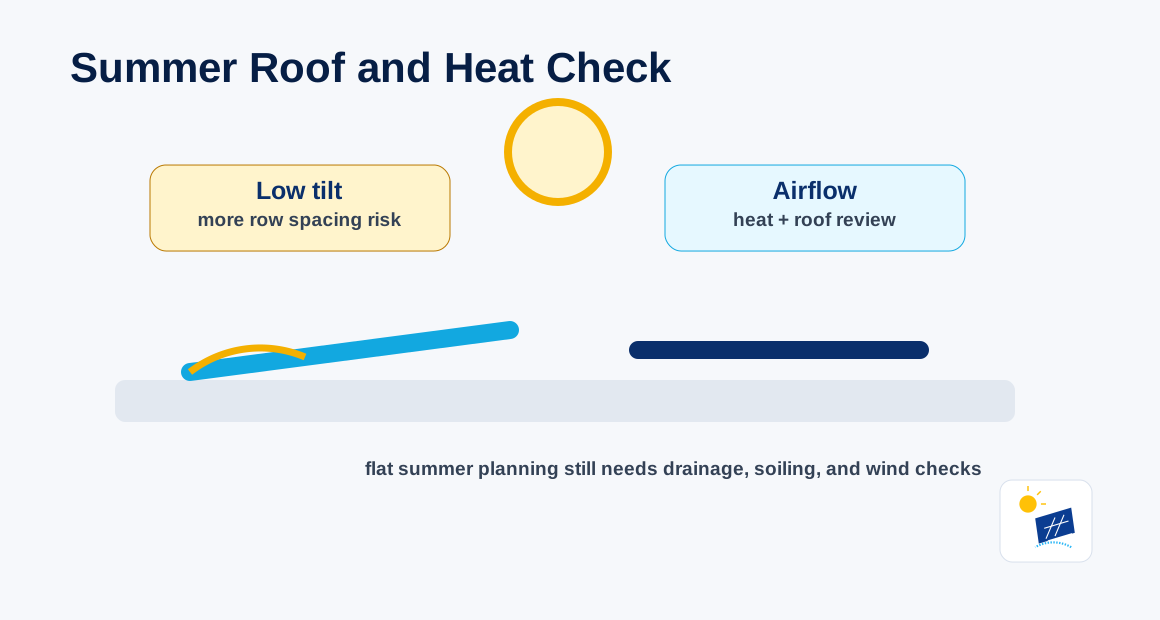
A 0 deg summer angle means the planning result is flat. A formula result below 0 deg is not used because negative tilt leans the panel away from the normal sun-facing side. A flat planning angle still needs soiling, drainage, wind, and mounting review.
Why is summer solar panel angle flatter?
Summer solar panel angle is flatter because the summer sun path is higher. A lower panel tilt aligns the module face with higher solar elevation during long daylight periods.
The summer tilt rule is a mechanism response to seasonal sun height. The sun's path rises higher in the summer sky for the relevant hemisphere. The panel angle becomes flatter to follow that vertical shift.
How does solar declination raise the sun path?
Solar declination is the sun's angular position north or south of the equator. NOAA solar calculation details include declination as part of solar position calculations. Summer occurs when the local hemisphere tilts toward the sun, raising the apparent sun path.
How does solar elevation change panel tilt?
Solar elevation measures the sun's height above the horizon. Higher solar elevation sends sunlight from a steeper overhead direction. A flatter panel angle reduces the mismatch between the panel face and the summer sun path.
Why does summer tilt not use a solstice-only angle?
Summer tilt does not use a solstice-only angle because a panel collects sunlight across a season, not only at noon on the solstice. A solstice-only angle is a momentary geometry value. The site formula uses a practical seasonal offset of 15 deg.
How do you calculate summer tilt by location?
Summer tilt by location is calculated by converting the location to latitude, subtracting 15 deg, and checking hemisphere. ZIP code and city tools work by finding latitude first.
Location is the input path. Latitude is the calculation input. Hemisphere is the seasonal calendar input. These 3 pieces keep the summer result tied to the right place and month.
How do you use latitude directly?
Use latitude directly by subtracting 15 deg from the absolute latitude value. A 34 deg latitude site gives 19 deg summer tilt. A 42 deg latitude site gives 27 deg summer tilt. The result is measured from horizontal.
How do you use ZIP code or city indirectly?
Use ZIP code or city indirectly by converting the place to latitude. A ZIP code lookup identifies the location. The location supplies latitude. The calculator then applies the summer formula to that latitude.
How does the Southern Hemisphere change the month?
The Southern Hemisphere changes the month because summer occurs around December through February. The formula remains latitude - 15 deg, but the seasonal label moves. Australia, South Africa, Chile, and much of Brazil use summer tilt when Northern Hemisphere users use winter tilt.
When is a flat summer angle not practical?
A flat summer angle is not practical when soiling, drainage, roof pitch, wind exposure, racking limits, or safe access requires a steeper or fixed installed angle.
Very low tilt can fit solar geometry and still fail practical planning. The panel surface, roof plane, and environment decide whether the angle works.
How does soiling change low-tilt decisions?
Soiling changes low-tilt decisions because dust, pollen, leaves, and debris clear less easily from flatter surfaces. NREL PVWatts includes monthly soiling loss inputs in its PV modeling workflow. A slightly steeper tilt can improve drainage and surface cleaning in some sites.
How does roof pitch override summer tilt?
Roof pitch overrides summer tilt when panels are flush-mounted. A 28 deg roof remains about 28 deg even when the summer formula gives 15 deg. The formula becomes a comparison point, not the installed angle.
How do wind and racking limits change the setting?
Wind and racking limits change the setting by restricting how the panel can be mounted. A low summer tilt on a flat roof requires ballast and spacing review. A tilted rack increases wind exposure. Final installation decisions require site review.
How do azimuth and shade change summer tilt?
Azimuth and shade change summer tilt because a correct vertical angle still fails when the panel faces the wrong direction or loses sunlight to obstructions.
Summer tilt controls vertical angle. Azimuth controls compass direction. Shade controls whether sunlight reaches the panel surface at the target time.
Why does azimuth matter after tilt?
Azimuth matters after tilt because panel orientation has 2 dimensions. NREL PVWatts uses tilt and azimuth as separate PV inputs. A flat or low summer tilt still needs a useful compass direction.
Why does summer shade differ from winter shade?
Summer shade differs from winter shade because the sun path is higher and longer. Trees also carry leaves in many climates. Morning and evening shade can still matter because summer days stretch across a wider sky path.
How does sun position checking refine the result?
Sun position checking refines the result by showing solar elevation and azimuth for a specific date and time. NOAA Solar Calculator provides solar position outputs by place, date, and time. This helps connect summer tilt to actual sun-path conditions.
How does summer tilt connect to the rest of the calculator path?
Summer tilt connects to seasonal comparison, roof pitch comparison, orientation checking, and PV modeling. The summer angle is one planning result inside a larger solar geometry workflow.
The summer angle answers one query: how flat the panel target becomes during high-sun months. The next query usually asks whether that target fits the site.
When does seasonal and monthly tilt comparison matter?
Compare seasonal and monthly tilt when the mount can move safely. Seasonal tilt uses 3 settings. Monthly tilt uses 12 settings. Monthly values give more detail but require more repeated adjustment.
When does roof pitch comparison matter?
Compare roof pitch when the array is roof-mounted. The Roof Pitch to Solar Angle Calculator shows whether the roof plane sits near or far from the summer target.
When does PV modeling matter?
Use PV modeling after tilt and azimuth are known. NREL PVWatts uses tilt, azimuth, location, losses, array type, and weather data inputs. Summer tilt alone does not produce a full PV estimate.
What summer angle checks prevent bad results?
Summer angle checks prevent bad results by confirming that a flatter target still fits the roof, rack, surface conditions, and sun path.
A low summer target can be useful for high sun, but very flat panels can collect dust, pollen, leaves, and standing water in some settings. A flat roof rack also needs row spacing, ballast, wind review, and parapet shade checks before a low tilt is treated as practical.
Summer shade deserves its own review. Leaves, longer daylight hours, and low morning or evening sun can create shade even when midday exposure looks clear. A summer tilt result is strongest when the panel has usable azimuth, clean surface drainage, and open sky across the target season.
Source Notes
- C001-C002: NREL PVWatts V8 documents tilt and azimuth as PV system inputs.
- C007: NOAA Solar Calculator gives solar position outputs by place, date, and time.
- C011: Site methodology defines summer tilt as latitude - 15 deg.
- C018: NREL PVWatts V8 includes monthly soiling loss inputs and PV modeling fields.
Calculate your solar panel angle
Use the calculator with your location, roof, mount, and orientation context to turn the page answer into a usable planning result.
Calculate My Summer Angle