What is solar hour angle?
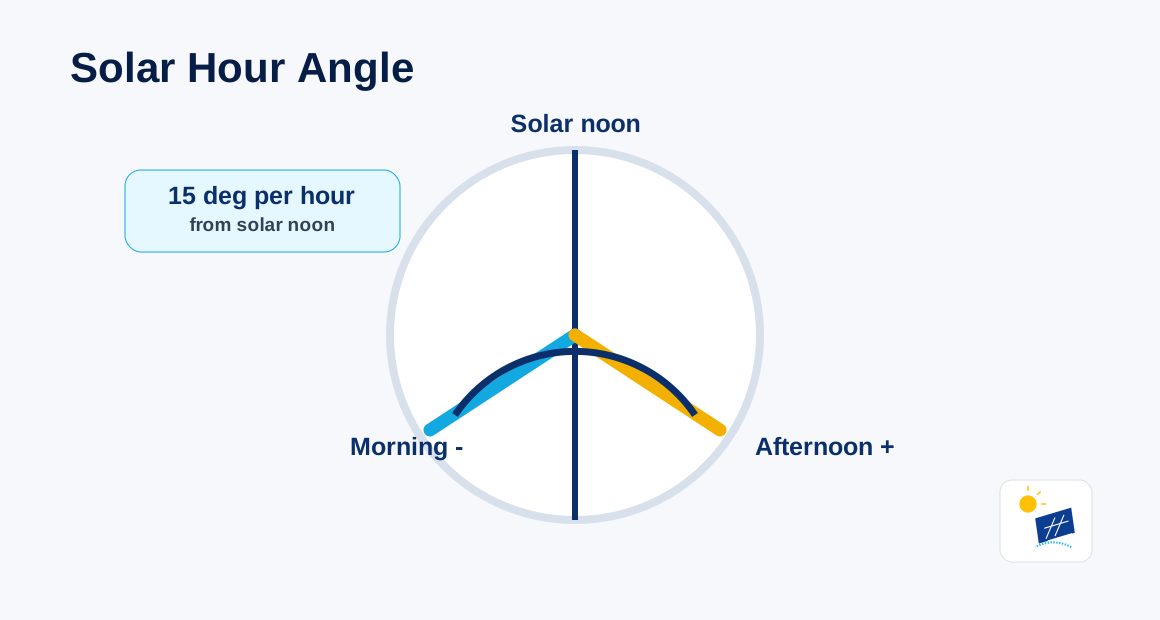
Solar hour angle measures how far the sun has moved from local solar noon, expressed as an angle.
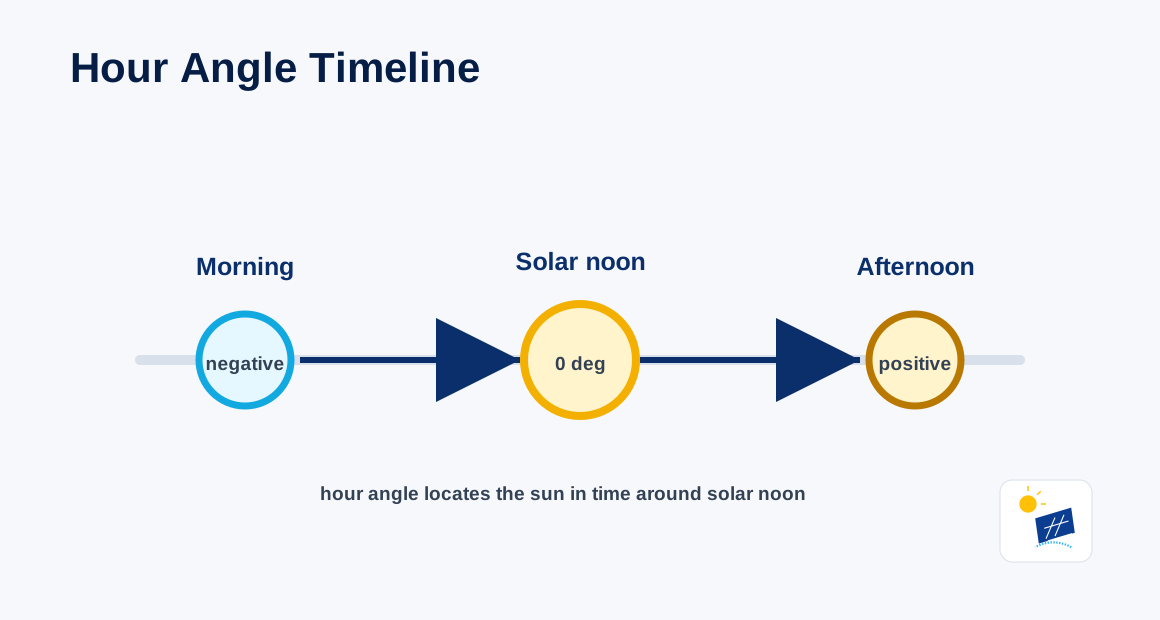
Local solar noon is the moment when the sun crosses the local meridian and reaches its highest daily position. Hour angle is 0 deg at that moment. Before solar noon, the value is usually treated as negative. After solar noon, the value is usually treated as positive.
NREL's Solar Position Algorithm uses date, time, latitude, longitude, and related corrections to calculate solar position for radiation applications. NOAA Solar Calculator also uses location, date, and time to return solar-position values.
Why does hour angle matter for solar panels?
Solar hour angle matters for solar panels because it turns time of day into sun-position geometry.
Panel direction is not only a compass question. A panel receives sunlight from different sun positions through the day. Hour angle helps define whether the sun is on the morning side, near solar noon, or on the afternoon side of the sky.
East-facing panels align better with negative hour-angle periods. West-facing panels align better with positive hour-angle periods. South-facing panels in the Northern Hemisphere often center around the stronger middle part of the daily arc. The roof decision still needs azimuth, tilt, shade, and site review.
How does solar hour angle relate to solar noon?
Solar hour angle is anchored to solar noon, not clock noon. Solar noon depends on longitude, time zone, date, and equation-of-time effects.
Clock noon is a civil-time label. Solar noon is a sun-position event. A property can reach solar noon before or after 12:00 p.m. on the clock because time zones cover wide longitude ranges and daylight saving time shifts clock labels.
This distinction matters when checking shade. A roof can be evaluated at 12:00 p.m. and still miss the actual highest sun position. A sun-position calculator removes the guesswork by translating local clock information into solar-position values.
How is hour angle connected to solar elevation and zenith?
Hour angle helps calculate solar elevation and solar zenith because the sun's height changes as the sun moves away from solar noon.
Solar Elevation Angle is generally highest near solar noon and lower in the morning and afternoon. Solar Zenith Angle is the opposite: zenith is lowest near solar noon and higher near sunrise or sunset. Hour angle supplies the time-of-day term in that vertical sun-position change.
At matching distances before and after solar noon, the sun can have a similar elevation but a different azimuth. That is why 10:00 a.m. and 2:00 p.m. solar time can look vertically similar while facing different sides of the sky. East and west roof comparisons depend on that distinction.
How is hour angle connected to azimuth?
Hour angle connects to azimuth because the sun's horizontal direction changes from the morning side to the afternoon side of the sky.
Solar Azimuth describes the sun's compass direction. Hour angle describes time position relative to solar noon. Together with latitude and declination, those values describe the local sun path. NOAA-style calculators return solar position because users need both direction and height.
The practical result is simple. Morning shade and afternoon shade are different problems. A chimney can shade panels during one hour-angle window. A tree line can affect only the west-facing part of the day. A roof comparison needs the hour-angle context behind the shade.
How does hour angle relate to 15 degrees per hour?
Solar hour angle changes by about 15 degrees per solar hour because Earth rotates 360 degrees in about 24 hours.
That relationship gives hour angle its name. One hour before solar noon corresponds to about -15 deg. Two hours after solar noon corresponds to about +30 deg. Solar-position algorithms refine the practical calculation with date, longitude, time zone, and equation-of-time details.
The 15-degree rule is useful for understanding the concept, not for replacing a calculator. A clock-time hour and a solar-time hour do not always line up exactly at a specific site. Local longitude and civil time rules shift the relationship between the clock and the sun.
How does hour angle affect solar calculators?
Solar hour angle affects solar calculators by turning a date and time entry into a specific sun-position state.
A solar-position calculator needs location, date, and time because the same roof has different sun exposure at different moments. The calculator uses time to locate the sun before calculating solar elevation, zenith, and azimuth. Hour angle is part of that time-to-sky translation.
Panel angle calculators often hide hour angle from the user because the output is a simpler tilt or orientation result. Sun-position calculators expose the time layer more directly. A user checking shade at 9 a.m., solar noon, and 4 p.m. is really sampling different hour-angle states.
How does hour angle affect fixed and tracking arrays?
Solar hour angle affects fixed arrays and tracking arrays differently because fixed panels stay still while trackers move with the sun path.
Fixed roof-mounted panels keep one tilt and one azimuth through the day. Hour angle changes the sun's position around that fixed surface. A tracker changes the panel surface to follow the sun more directly, depending on tracker type and control method.
PVWatts separates array type into fixed roof, fixed open rack, one-axis, one-axis backtracking, and two-axis categories. That separation matters because hour-angle movement creates different surface-alignment patterns for fixed and tracking systems.
How does hour angle affect east and west panels?
Solar hour angle affects east and west panels by separating morning exposure from afternoon exposure.
East Facing Solar Panels receive stronger direct exposure during the morning side of the sun path. West-facing panels receive stronger direct exposure during the afternoon side. The difference is not only "left side of roof versus right side of roof." It is time-specific solar geometry.
This is why an east-west comparison needs more than annual direction labels. A west roof with open afternoon sky can be more useful than an east roof with morning shade. An east roof with clear morning sky can be more useful than a west roof blocked by late-day trees. Hour angle explains the timing layer.
How does hour angle affect shade checks?
Hour angle affects shade checks by locating shadows within morning, midday, and afternoon time windows.
A solar panel shade check is incomplete when it uses one moment. Shadows move as hour angle changes. Morning shadows stretch from different directions than afternoon shadows. Midday shadows occur near the highest sun position and often have shorter length than low-sun shadows.
Winter adds another layer because lower sun elevation lengthens shadows across more hour-angle windows. A dormer, vent, parapet, ridge, or neighboring building can shade only part of the day. A good site interpretation records when shade crosses the array surface, not only whether shade exists.
What mistakes distort solar hour angle?
Solar hour angle mistakes include using clock noon as solar noon, treating hour angle as azimuth, and ignoring time zone or longitude.
Clock time is not solar geometry. A 12:00 p.m. inspection can happen before or after local solar noon. A time-zone boundary can make the difference larger. Daylight saving time shifts the clock label without changing the sun path.
Hour angle is also not panel direction. A positive hour angle does not mean a panel azimuth of 270 deg. It means the sun is after solar noon. The solar azimuth value describes the sun's compass direction, and panel azimuth describes the module face direction.
How do you use hour angle in solar planning?
Use solar hour angle to understand exposure timing, shade timing, and the difference between east and west panel behavior.
A practical workflow starts with location, date, and clock time. A solar-position calculator converts that information into local sun geometry. Solar azimuth identifies direction. Solar elevation or zenith identifies height. Hour angle explains where the sun sits relative to solar noon.
PVWatts accepts hourly output as a timeframe option and includes hourly output fields when configured that way. Hourly modeling is useful when the question is timing, but final production estimates still require full system inputs and solar-resource data.
Sources: NOAA Solar Calculator · NASA POWER Solar Data