What does roof pitch mean for solar panels?
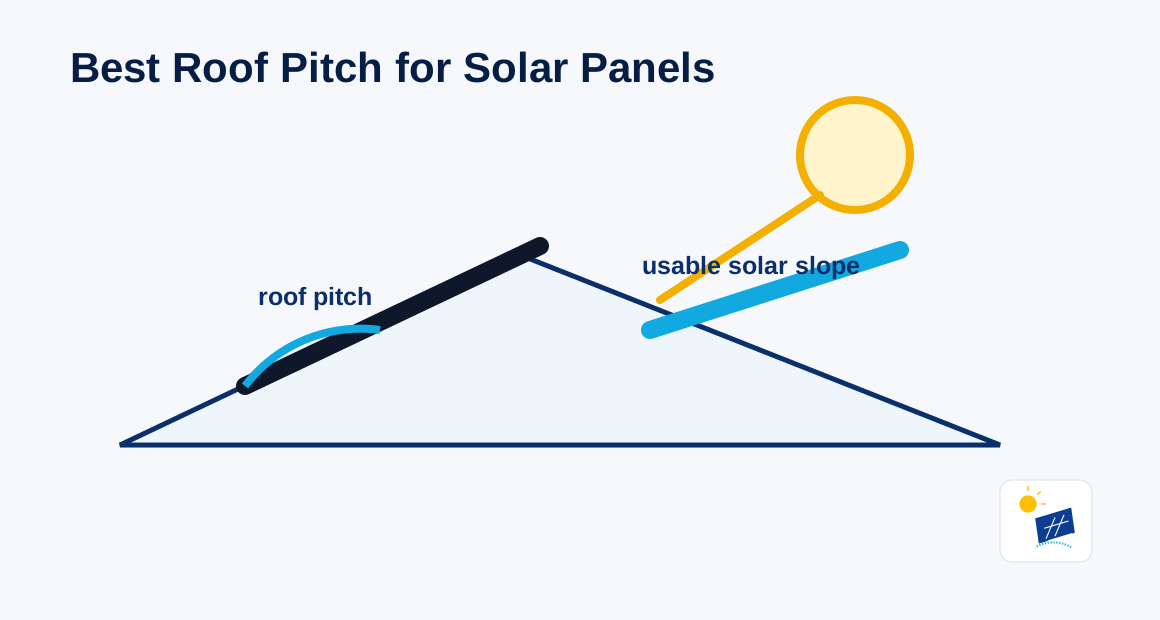
Roof pitch means the slope of the roof surface, and for flush-mounted solar panels it becomes the panel tilt.
Roof pitch can be expressed as rise over run, such as 6:12, or as degrees from horizontal. Solar calculators usually use degrees. A flat surface is 0 deg. A vertical surface is 90 deg. PVWatts uses tilt as a required input with a 0 deg to 90 deg range.
Roof pitch is not panel direction. Direction is azimuth. A roof can have a 30 deg pitch and face south, east, west, or north. Solar planning needs both pitch and direction because the panel surface has both slope and compass orientation.
What roof pitch is usually best for solar panels?
The best roof pitch is usually the pitch that gets the panel tilt close to the location's fixed solar angle while keeping the roof practical for installation.
A simple fixed-tilt baseline starts near the site's latitude under common site methodology. That means a 35 deg latitude location often uses a fixed angle near 35 deg as a starting concept. The roof pitch does not have to match exactly because annual performance changes gradually around the broad optimum and site constraints matter.
The word "best" needs a practical definition. A mathematically stronger pitch with heavy shade or poor roof condition is not the best usable roof surface. A slightly less ideal pitch with clear exposure, good direction, and safer access can be the better solar surface.

How do you convert roof pitch to degrees?
Roof pitch converts to degrees by turning rise-over-run into an angle from horizontal.
A 6:12 roof rises 6 units for every 12 units of horizontal run. The degree angle is the arctangent of rise divided by run. Many roof pitch charts convert common pitch ratios into degrees for easier solar calculator entry.
Common examples:
| Roof pitch | Approximate degrees | Solar meaning |
|---|---|---|
| 3:12 | 14 deg | low-slope roof |
| 4:12 | 18 deg | moderate-low slope |
| 6:12 | 27 deg | common residential slope |
| 8:12 | 34 deg | steeper residential slope |
| 12:12 | 45 deg | steep roof |
The roof pitch to degrees conversion matters because solar tools usually ask for tilt in degrees, not roof-pitch ratio. Entering "6" for a 6:12 pitch would be wrong if the calculator expects degrees.
How does latitude change the best roof pitch?
Latitude changes the best roof pitch because the useful fixed tilt usually rises as latitude increases.
Solar Panel Angle by Latitude often uses lower fixed tilt baselines at lower latitudes and steeper fixed tilt baselines at higher latitudes. PVWatts requires latitude and longitude when a climate file is not supplied, which shows that solar modeling is location-dependent.
A roof pitch that works well in Florida can be shallow for Minnesota. A pitch that works well in Oregon can be steep for southern Arizona. The same roof pitch does not carry the same meaning everywhere because the sun path changes with latitude.
Latitude also interacts with season. A summer-focused angle is lower than the annual baseline. A winter-focused angle is steeper than the annual baseline. Roof pitch fixes the flush-mounted tilt, so seasonal optimization is limited unless the system uses adjustable racking.
How does roof direction change roof-pitch value?
Roof direction changes roof-pitch value because pitch only describes slope, while azimuth describes which part of the sun path the slope faces.
PVWatts treats tilt and azimuth as separate required inputs. That separation is crucial for roof pitch decisions. Solar Azimuth makes a 30 deg south-facing roof and a 30 deg west-facing roof different solar surfaces. The slope is identical, but the direction changes exposure timing.
In the Northern Hemisphere, true south is often the fixed-panel reference. East roofs emphasize morning sun. West roofs emphasize afternoon sun. North-facing roofs are usually constraint cases in the Northern Hemisphere and equator-facing candidates in the Southern Hemisphere.
How does shade change the best roof pitch?
Shade changes the best roof pitch because sunlight access can outweigh a cleaner geometric angle.
DOE Energy Saver guidance identifies sunlight reaching the site as a solar planning factor. A roof with a near-ideal pitch loses value when trees, chimneys, dormers, parapets, hills, or neighboring buildings block the sun path. A roof with a less ideal pitch can be better when it has clearer exposure.
Shade also changes by season. Winter sun sits lower in many locations, so shadows grow longer. A roof that looks clear in summer can have winter shade. A pitch decision needs morning, midday, afternoon, summer, and winter checks.
Is a flat roof pitch good for solar panels?
A flat or low-slope roof can work for solar panels when racking sets the final panel tilt and direction.
Flat Roof Solar Panel Angle gives more control than steep roofs because the array does not have to follow a strong roof slope. Racks can set the panel tilt, orient rows, and manage spacing. The tradeoff is physical design: wind exposure, row-to-row shade, ballast or attachment method, drainage, roof membrane protection, and maintenance access.
A flat roof's "pitch" is therefore not the final panel angle when racking is used. The final panel surface comes from the racking design. The roof still matters because structure, waterproofing, access, and drainage set the practical boundary.
Is a steep roof pitch good for solar panels?
A steep roof pitch can work for solar panels when the direction, shade, roof condition, and access are practical.
Steep roofs can align better with lower winter sun in some locations. Steep roofs can also create mounting and service constraints. Worker access, roof attachments, wind loading, snow behavior, and visual placement become more important as slope increases.
A steep north-facing roof in the Northern Hemisphere is often a weak combination because the panel surface points away from the main sun path. A steep south-facing roof can be more useful, depending on latitude and shade. The direction-pitch pair matters more than pitch alone.
What roof pitch is too shallow for solar panels?
A roof pitch is too shallow only when the final mounted surface creates drainage, soiling, row spacing, shade, or mounting problems for the planned array.
Low-slope roofs are not automatically bad for solar panels. A low roof pitch can accept racking that sets the panel angle independently. The practical constraints are roof membrane protection, drainage, ballast or attachment method, maintenance access, and row-to-row shade.
Very shallow flush-mounted panels can collect more dirt, leaves, pollen, or snow in some climates. That condition is a maintenance and site-context issue, not a universal angle failure. A local installer review determines whether racking or another roof plane is more practical.
What roof pitch is too steep for solar panels?
A roof pitch is too steep when access, structural attachment, wind exposure, roof condition, or direction makes the surface impractical for the planned array.
Steep roofs can align well with lower seasonal sun when the direction is favorable. The same steep roof can be difficult for installation and service. Roof age, material, fall protection, attachment layout, and local wind conditions become more important as the slope increases.
A steep pitch also magnifies direction errors. A steep south-facing roof in the Northern Hemisphere and a steep north-facing roof in the same location do not have the same solar meaning. The slope points the panel face more strongly toward its azimuth.
How does roof material change pitch decisions?
Roof material changes pitch decisions because mounting hardware, waterproofing, access, and roof condition vary by surface type.
Asphalt shingle, standing-seam metal, tile, membrane, and other roof types create different attachment details. The solar angle can look useful on paper, but the roof material controls how panels can be attached and serviced. A roof near replacement age can also change the project sequence.
Material does not change the solar geometry. Material changes the installation boundary around that geometry. A good roof pitch still requires a roof surface that can accept attachments, preserve waterproofing, and leave safe access paths.
How does mount type change roof pitch decisions?
Mount type changes roof pitch decisions because flush mounts follow the roof, while racks can create a different panel angle.
PVWatts separates fixed roof-mounted, fixed open-rack, and tracking array types. That distinction matters for roof pitch. A flush roof-mounted system uses the roof plane as the panel plane. An open-rack or adjusted system can set a different slope and direction.
Racking is not a free correction. It changes wind exposure, structural loading, attachment design, waterproofing, row spacing, and visual profile. A site review determines whether changing the panel angle is practical on a specific roof.
What mistakes distort roof-pitch decisions?
Roof-pitch mistakes include treating pitch as direction, using pitch ratio as degrees, ignoring shade, and applying one ideal pitch to every location.
Pitch is slope. Azimuth is direction. Latitude sets local solar geometry. Shade controls sunlight access. Mount type defines whether the panel follows the roof or uses a separate rack angle.
The safest interpretation is measured and specific. Convert roof pitch to degrees. Measure true azimuth. Check shade across seasons. Compare mount options. Then use a calculator or PV model with the correct fields.
Sources: US Department of Energy · IEA Solar PV