
What is the best solar panel angle by season?
The best solar panel angle by season is latitude in spring and fall, latitude - 15 deg in summer, and latitude + 15 deg in winter. Adjustable mounts use this pattern most directly.
Seasonal solar panel angle is a 3-position tilt schedule. The schedule exists because the sun path changes through the year. A fixed roof array often stays at roof pitch, while an adjustable array can follow seasonal targets.
What angle fits spring?
Spring angle usually equals latitude. Spring sun height moves upward from winter toward summer. The latitude baseline gives a middle setting between steep winter tilt and flatter summer tilt.
What angle fits summer?
Summer angle usually equals latitude - 15 deg. Summer sun height is higher, so the panel tilts flatter. A 35 deg latitude site uses about 20 deg summer tilt. A 45 deg latitude site uses about 30 deg summer tilt.
What angle fits fall and winter?
Fall angle usually returns to latitude. Winter angle usually equals latitude + 15 deg. Winter sun height is lower, so the panel tilts steeper. A 35 deg latitude site uses about 50 deg winter tilt.
Why does the best seasonal angle change?
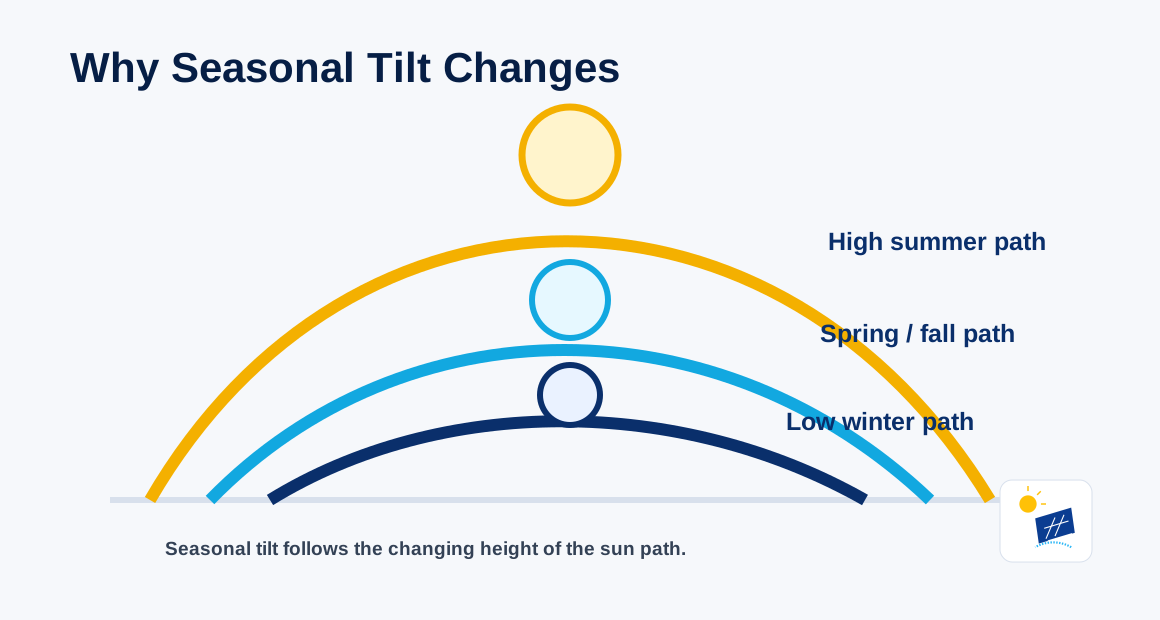
The best seasonal angle changes because Earth's seasonal sun path changes solar elevation. Higher summer sun needs flatter tilt. Lower winter sun needs steeper tilt.
Seasonal tilt follows solar geometry. The panel angle changes to reduce the mismatch between the panel face and the seasonal sun path. This is a vertical alignment problem, not a financial or system-sizing problem.
How does Earth's tilt create seasonal sun paths?
Earth's tilted axis creates seasons by changing where direct sunlight concentrates during the year. NASA Space Place explains that Earth's tilt causes opposite seasons in the Northern and Southern Hemispheres. This reversal controls which months use summer or winter tilt.
How does solar declination change solar elevation?
Solar declination is the sun's angle north or south of the equator. NOAA solar calculation details include solar declination in the solar position workflow. Declination changes solar elevation, and solar elevation changes the practical panel tilt.
How does incidence angle explain the seasonal adjustment?
Incidence angle explains seasonal adjustment because a panel receives sunlight most directly when sunlight approaches the panel face more squarely. NREL Solar Position Algorithm includes incidence-angle calculation for tilted surfaces. Seasonal tilt changes the panel plane to reduce that angle during the target season.
Which seasonal tilt fits each mount type?
Seasonal tilt fits mounts that can move safely. Ground mounts and pole mounts fit seasonal changes better than flush roof arrays because roof pitch usually controls flush-mounted panel angle.
Mount type is the practical filter for seasonal tilt. The formula can produce a target angle, but hardware decides whether that target can be used.
How do flush roof arrays use seasonal targets?
Flush roof arrays use seasonal targets as comparison values. The installed angle follows roof pitch. A roof at 28 deg stays near 28 deg in summer and winter unless racking changes the panel plane. The seasonal target shows the difference between ideal tilt and roof tilt.
How do ground mounts use seasonal targets?
Ground mounts can use seasonal targets when the structure includes adjustable tilt positions. The user can set summer, winter, and shoulder-season angles without roof access. The practical limits are hardware strength, wind exposure, and safe handling.
How do pole mounts, flat roofs, and trackers differ?
Pole mounts often support adjustable seasonal tilt. Flat-roof racks can use fixed or adjustable tilt, but ballast and wind design control the limit. Trackers change the angle during the day or year, so the fixed seasonal formula becomes a reference rather than the main control.
How do latitude and hemisphere change seasonal angle?
Latitude changes the size of the seasonal angle. Hemisphere changes the calendar and the preferred facing direction. Northern Hemisphere arrays generally face true south; Southern Hemisphere arrays generally face true north.
Latitude sets the baseline. Hemisphere sets the seasonal order and equator-facing direction. These 2 inputs must stay separate because they answer different parts of the solar geometry problem.
How does latitude change the steepness?
Latitude changes steepness by raising the baseline angle away from the equator. A 20 deg latitude site uses 20 deg fixed tilt, 5 deg summer tilt, and 35 deg winter tilt. A 50 deg latitude site uses 50 deg fixed tilt, 35 deg summer tilt, and 65 deg winter tilt.
How does hemisphere reverse summer and winter?
Hemisphere reverses summer and winter months. Northern Hemisphere winter usually falls around December through February. Southern Hemisphere winter usually falls around June through August. The formula stays consistent, but the month labels change.
How does azimuth complete the seasonal result?
Azimuth completes the seasonal result by setting compass direction. NREL PVWatts uses azimuth as a PV model input. Seasonal tilt controls vertical angle. Azimuth controls whether the panel faces the equator-side sun path.
When does seasonal tilt beat fixed tilt?
Seasonal tilt beats fixed tilt when the mount is adjustable, the array is safe to reach, and the user wants seasonal alignment rather than one low-maintenance annual angle.
Seasonal tilt adds value only when the system can actually change angle. The decision is not "seasonal is always better." The decision is whether seasonal control fits the site and mount.
When is winter output the priority?
Winter output becomes the priority when low winter sun, shorter days, and snow behavior dominate the user's planning concern. A steeper winter angle faces the lower sun path more directly. Snow shedding can also improve with steeper tilt, depending on site conditions.
When is summer output the priority?
Summer output becomes the priority when high sun and long daylight periods matter most. A flatter summer angle aligns better with the high summer sun path. Low tilt also increases soiling and drainage concerns in dusty or leafy areas.
When is low maintenance the priority?
Low maintenance becomes the priority when access is difficult, roof work is unsafe, wind exposure is high, or the owner wants fewer manual changes. Fixed tilt or roof pitch often fits these systems better than seasonal adjustment.
How do roof pitch, shade, and access change seasonal angle?
Roof pitch, shade, and access change seasonal angle because the formula gives a target, while the site decides whether the target is usable.
Roof pitch controls the installed angle for flush-mounted panels. A 25 deg roof stays near 25 deg even when a winter target says 55 deg. The seasonal number becomes a comparison value unless racking changes the panel plane. Racking can improve tilt alignment, but it also changes wind exposure, attachment loads, waterproofing, row spacing, and service access.
Shade controls whether the seasonal angle receives sunlight. Winter shade is often the strictest condition because low solar elevation creates longer shadows from trees, chimneys, dormers, parapets, nearby buildings, and terrain. Summer shade can still matter when leaves, roof equipment, or morning and evening obstructions cross the panel surface.
Access controls whether an adjustable schedule is realistic. A ground rack with safe access can use seasonal settings more easily than a steep roof array. A seasonal tilt plan that cannot be changed safely behaves like fixed tilt in real use.
How do you use seasonal angles in a calculator?
Use seasonal angles in a calculator by entering the location, season, mount type, and actual installed panel angle.
The formula gives a target angle for the season. The calculator result becomes stronger when the user also checks roof pitch, true azimuth, shade, and whether the array is fixed or adjustable. The target angle and actual angle can then be compared without confusing ideal geometry with installed hardware.
Seasonal angle is an educational planning value. PV production estimates require a performance model such as PVWatts or installer software because output also depends on weather data, system capacity, losses, module behavior, and array type.
Use one tool after this page: Calculate My Solar Panel Angle.
What seasonal angle mistakes reduce accuracy?
Seasonal angle mistakes include using the wrong hemisphere, ignoring roof pitch, ignoring azimuth, applying adjustable values to fixed roofs, and treating tilt as a full PV production estimate.
Seasonal angle is a geometry estimate. The most common errors come from treating the estimate as a complete design answer.
Why is using the wrong hemisphere a major error?
Wrong hemisphere reverses the month schedule. A December winter table fits Northern Hemisphere planning, not Australia, South Africa, or Chile. Southern Hemisphere sites use winter tilt around June and July.
Why is ignoring roof pitch a major error?
Ignoring roof pitch creates an installability error. A 55 deg winter target cannot be applied to a 25 deg flush roof without additional racking. Additional racking changes wind, structure, waterproofing, and code questions.
Why is treating tilt as a production estimate a major error?
Treating tilt as a production estimate is a major error because PV modeling uses more inputs. NREL PVWatts uses tilt, azimuth, location, weather data, system capacity, losses, and array type. Tilt is one model input, not the model.
Source Notes
- C001-C002: NREL PVWatts V8 documents tilt and azimuth as PV model inputs.
- C005: NREL Solar Position Algorithm includes incidence-angle calculation.
- C007: NOAA Solar Calculator includes solar declination and solar position calculations.
- C009-C012: DOE guidance and site methodology define site review, latitude baseline, seasonal offsets, and monthly logic.
- NASA Space Place explains that Earth's axial tilt creates opposite seasons by hemisphere.
Calculate your solar panel angle
Use the calculator with your location, roof, mount, and orientation context to turn the page answer into a usable planning result.
Calculate My Seasonal Angle