What is the best angle for solar panels?
The best angle for solar panels starts with fixed tilt equal to latitude, then changes by season and mount type. Roof pitch, azimuth, shade, and access decide the usable installed angle.
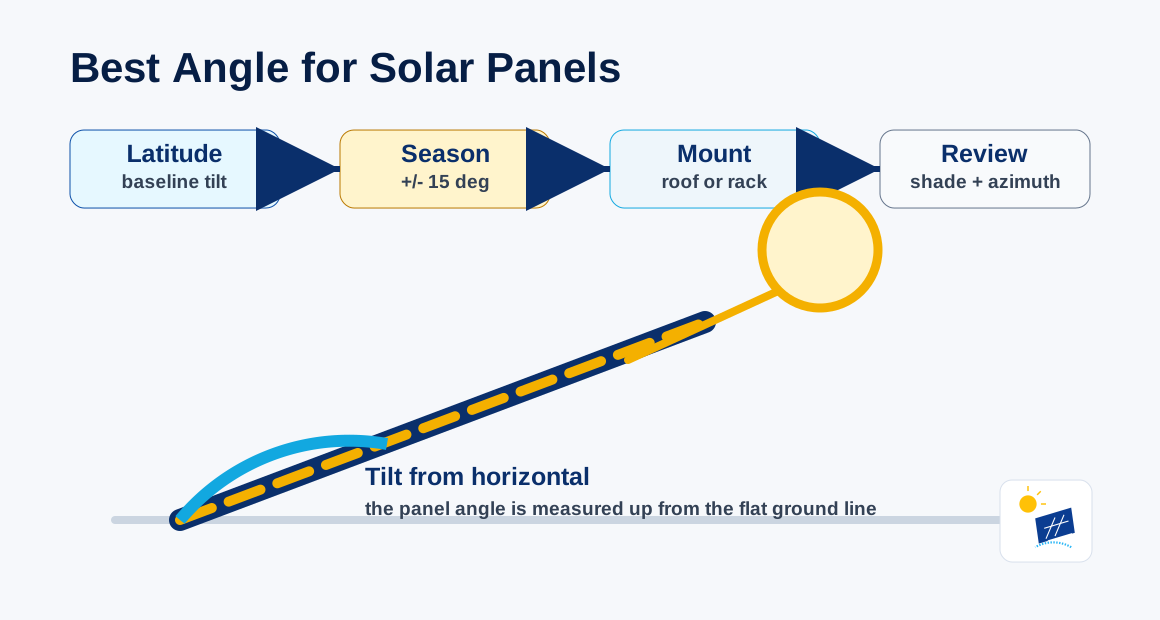
Solar panel angle is the panel tilt measured from horizontal. NREL PVWatts uses tilt as a PV input with valid values from 0 deg to 90 deg. A 0 deg angle is flat. A 90 deg angle is vertical. Most planning questions sit between those two limits.
The practical fixed-angle rule is:
Fixed solar panel angle = site latitudeThe practical seasonal rule is:
Summer solar panel angle = latitude - 15 deg
Winter solar panel angle = latitude + 15 deg
Spring and fall solar panel angle = latitude
These formulas are educational planning rules. They do not approve a roof design, predict a full PV output result, or replace a site assessment. DOE guidance states that solar potential depends on how much sunlight reaches the site and system size. DOE also identifies contractor or installer assessment as the step that accounts for home-specific variables online tools miss.
How does location change the best angle?
Location changes the best angle because latitude changes the sun path. Higher latitudes use steeper baseline tilt, while lower latitudes use flatter baseline tilt.
Latitude is the north-south position of a site measured in degrees from the equator. PVWatts uses latitude and longitude as location inputs. The reason is simple: a solar panel in Minnesota, Texas, Oregon, and Florida does not face the same annual sun path.
How does latitude set the baseline?
Latitude sets the baseline because fixed tilt follows the site's north-south position. A 25 deg latitude site uses about 25 deg fixed tilt. A 40 deg latitude site uses about 40 deg fixed tilt. A 50 deg latitude site uses about 50 deg fixed tilt. These values are measured from horizontal, not from the roof surface.
How does hemisphere change seasonal timing?
Hemisphere changes seasonal timing because the Northern and Southern Hemispheres have opposite seasons. NASA explains that Earth's tilt creates opposite seasons between hemispheres. Northern Hemisphere panels use the summer-angle pattern around June and July. Southern Hemisphere panels use the summer-angle pattern around December and January.
Location also changes the preferred direction. Northern Hemisphere fixed panels generally face True South. Southern Hemisphere fixed panels generally face true north. Direction belongs to azimuth, not tilt, but the best angle decision is incomplete without it.
How does season change the best angle?
Season changes the best solar panel angle because the sun path moves higher in summer and lower in winter. Summer tilt is flatter; winter tilt is steeper.
Solar Panel Angle by Season uses the same latitude baseline with two offsets. Summer tilt subtracts 15 deg from latitude. Winter tilt adds 15 deg to latitude. Spring and fall stay near latitude. A 40 deg latitude site uses about 25 deg in summer, 40 deg in spring and fall, and 55 deg in winter.
Seasonal adjustment matters most for arrays that can move safely. Ground mounts, pole mounts, and adjustable racks can use seasonal settings. Flush roof arrays usually stay fixed because the roof plane sets the installed angle. Monthly tilt goes further by using 12 settings, but monthly adjustment only fits accessible mounts built for repeated changes.
The seasonal logic follows solar elevation. Solar elevation is the sun's height above the horizon. NOAA Solar Calculator provides solar position details by place, date, and time, including elevation and azimuth outputs. A high summer sun path needs a flatter panel. A low winter sun path needs a steeper panel.
Which best angle fits the real planning goal?
The best angle changes with the planning goal. Annual output uses latitude as the baseline, summer priority uses a flatter setting, winter priority uses a steeper setting, and roof planning uses the roof's actual slope.
Many users search for one number, but the hidden question is usually different. A homeowner comparing a roof to a calculator needs to know whether the roof pitch is close enough to the target. A user with a ground rack needs to know whether one annual setting is enough. A user in a snowy or dusty place needs to know whether a very flat angle creates maintenance concerns. A user comparing summer and winter values needs to know whether the mount can safely move.
Annual priority means the tilt is trying to balance the high summer sun and the low winter sun across the year. Latitude is the cleanest single-number starting point for that use. Summer priority means the panel tilts closer to flat so the panel face aligns better with the high sun path. Winter priority means the panel tilts steeper because the sun stays lower above the horizon. Roof priority means the best theoretical value gives way to what the roof plane, attachment method, wind exposure, and access allow.
The best-angle decision therefore works as a sequence: identify the latitude, choose fixed or seasonal intent, compare the target to roof pitch, check azimuth, check shade, then decide whether adjustment is physically practical. Skipping any step creates a number that looks precise but does not describe the actual panel surface.
How do roof pitch, azimuth, and shade change the best angle?
Roof pitch, azimuth, and shade change the best angle because a mathematical tilt target is not always the usable site angle. The roof sets slope, direction sets azimuth, and shade limits sunlight.
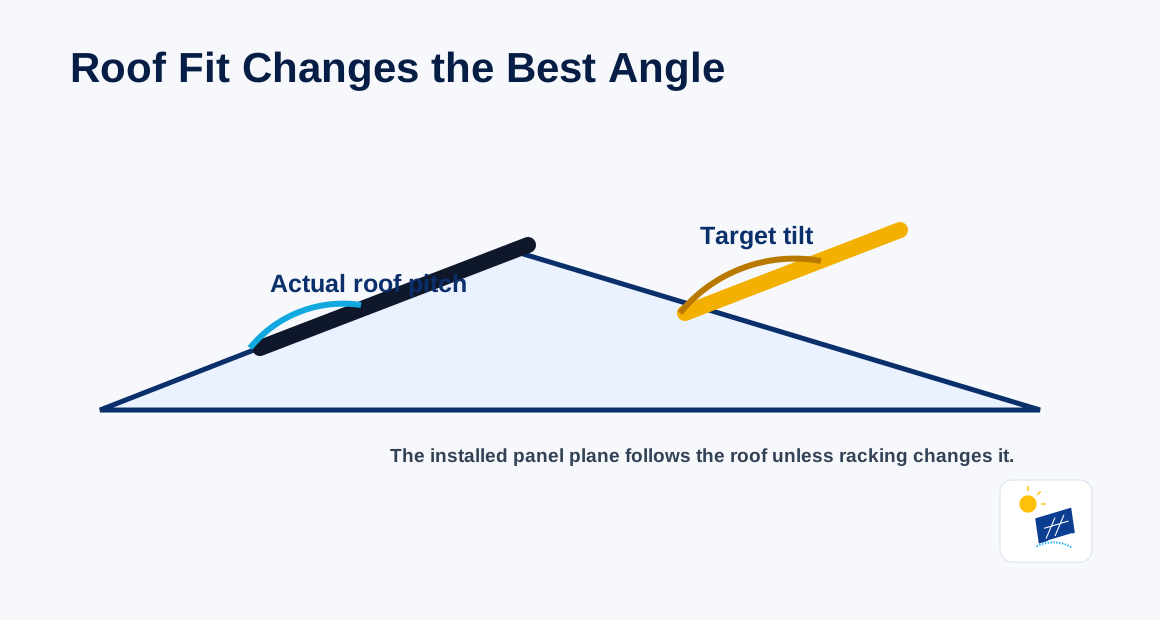
Roof Pitch is the roof slope expressed as an angle from horizontal. A flush-mounted panel follows that roof slope. A 32 deg target does not create a 32 deg installed panel on a 24 deg roof unless racking changes the panel plane.
How does roof pitch override the target?
Roof pitch overrides the target when panels sit flush on the roof. A 35 deg latitude target and a 25 deg roof create a 10 deg difference. That difference is a planning note. It is not an automatic reason to add tilt racks because racking changes wind exposure, roof loading, waterproofing, and access.
How does azimuth complete the result?
Solar Azimuth completes the result because tilt only describes vertical angle. Azimuth describes compass direction. NREL PVWatts uses azimuth as a separate input with valid values from 0 deg to less than 360 deg. A panel with a good tilt and poor azimuth can still miss the strongest part of the sun path.
Shade can dominate both tilt and azimuth. Trees, chimneys, dormers, vents, ridgelines, and nearby buildings reduce sunlight reaching the panel surface. DOE guidance ties solar potential to sunlight reaching the site. A perfect-looking angle is weak when the roof plane is shaded.
Which angle works for fixed, seasonal, monthly, and roof-mounted panels?
Fixed systems use one annual angle, seasonal systems use broad summer and winter adjustments, monthly systems use 12 settings, and roof-mounted systems usually use the roof pitch angle.
Tilt mode depends on the mount. NREL PVWatts separates array types such as fixed open rack, fixed roof mounted, 1-axis, 1-axis backtracking, and 2-axis. A fixed roof mount and a tracker do not solve the angle problem the same way.
The decision table gives the practical match:
| System type | Best-angle starting point | Main constraint |
|---|---|---|
| Fixed ground mount | latitude | one annual setting |
| Adjustable seasonal mount | latitude, latitude - 15 deg, latitude + 15 deg | safe adjustment access |
| Monthly adjustable mount | 12-step seasonal schedule | frequent maintenance |
| Flush roof mount | roof pitch | roof plane sets angle |
| Flat roof rack | latitude or low-profile racking target | wind, ballast, row spacing |
| Tracker | tracking algorithm | tracker type and range |
NREL PVWatts includes monthly soiling inputs that reduce incident irradiance. That matters because flatter summer angles can collect more dust, pollen, or debris. Steeper winter angles can help snow shedding in some conditions, but they also increase wind and access concerns.
What mistakes make a best-angle estimate wrong?
Best-angle mistakes include using one universal angle, ignoring roof pitch, ignoring azimuth, ignoring shade, applying monthly tilt to fixed roofs, and treating tilt as a complete production estimate.
One universal angle fails because latitude changes the sun path. A state or country estimate is useful for scanning, but Solar Panel Angle by Location gives a tighter result. A roof pitch comparison gives the installed tilt for flush-mounted panels. Azimuth checks the compass direction. Shade checks whether sunlight reaches the panel at all.
The biggest interpretation mistake is treating angle as the full result. PVWatts uses tilt, azimuth, location, array type, losses, and weather data as part of the model. Panel angle is one input, not the whole PV estimate.
Final installation decisions require site review. The best angle gives a planning result a homeowner, DIY solar buyer, or installer can discuss. It does not replace roof assessment, structural review, local code, mounting hardware limits, or professional installation judgment.
Another mistake is mixing measurement references. Solar panel tilt is measured from horizontal. Roof pitch is sometimes described as rise over run, such as 6:12, instead of degrees. Compass direction is azimuth, not tilt. Sun height is solar elevation, not panel angle. These terms connect to the same solar-orientation problem, but they are not interchangeable. A clear answer keeps each entity in its own place: latitude sets the baseline, tilt sets slope, azimuth sets direction, roof pitch sets the installed roof plane, shade controls sunlight access, and mount type controls whether the panel can move.
A final mistake is over-optimizing a number before checking the roof. If a roof-mounted array is already close to the latitude target, the difference between target tilt and roof pitch is often a planning note rather than a design problem. If the roof pitch is far from the target, the next question is not only "what angle is best?" It becomes "does a different racking plane fit this roof, wind exposure, row spacing, waterproofing, maintenance access, and local approval path?" That broader question is why the best-angle answer stays educational until site review confirms it.
Use the site calculator after this page when you need a location-specific planning result.
Sources: US DOE Solar Energy Technologies · NOAA Solar Calculator