
What is the optimal solar panel angle in Oregon?
The optimal Oregon solar panel angle starts with local latitude. Most Oregon fixed-tilt estimates fall near 42 deg to 46 deg, then shift flatter for summer and steeper for winter.
Oregon is not one solar-angle location. The coast, Willamette Valley, Cascades, southern Oregon, and high desert create different planning conditions. A statewide angle works as a quick starting point; ZIP code, city, address, or exact latitude gives the tighter estimate.
| Oregon planning mode | Typical planning range | Method |
|---|---|---|
| Fixed tilt | about 42 deg to 46 deg | latitude baseline |
| Summer tilt | about 27 deg to 31 deg | latitude - 15 deg |
| Winter tilt | about 57 deg to 61 deg | latitude + 15 deg |
The table uses the site methodology for fixed, summer, and winter tilt. The range exists because Oregon cities do not share one latitude.
How do Oregon cities change the angle?
Oregon cities change the angle because each city has a different latitude. Portland, Eugene, Bend, Medford, Salem, Astoria, and Ashland belong in different local tilt contexts.
U.S. Census Gazetteer place records provide internal point latitude and longitude for Oregon places. City-level lookup is more useful than one statewide number because it narrows the latitude range before roof checks begin.
| Oregon area | Planning latitude context | Fixed tilt context |
|---|---|---|
| Ashland / southern Oregon | near 42 deg north | low 40s |
| Medford / Rogue Valley | near 42 deg north | low 40s |
| Eugene / Willamette Valley | near 44 deg north | mid 40s |
| Bend / central Oregon | near 44 deg north | mid 40s |
| Portland-area cities | near 45 deg north | mid 40s |
| Astoria / north coast | near 46 deg north | mid 40s |
City numbers still need roof review. A Eugene roof with heavy tree shade can need more planning attention than a small tilt difference between Eugene and Bend.
How do Oregon regions change the final angle?
Oregon regions change the final angle because sunlight, shade, snow, dust, wind, roof access, and weather differ between the coast, Willamette Valley, Cascades, southern valleys, and high desert.
DOE guidance states that solar potential depends on how much sun reaches the site. That point matters strongly in Oregon because trees, hills, coastal weather, snow, and roof orientation can dominate small tilt changes.
The Oregon coast adds wind exposure, cloud patterns, salt air, and roof-direction constraints. The Willamette Valley adds tree shade, winter cloud patterns, and east-west roof questions. Central and eastern Oregon add high-desert dust, snow, stronger sun exposure, and wider seasonal conditions.
How do snow and dust change Oregon tilt planning?
Snow and dust change Oregon tilt planning because surface cover can block sunlight before the angle target matters. NREL PVWatts includes monthly soiling inputs for reductions in incident irradiance. Steeper winter tilt can help snow shedding in some locations, but wind exposure and access still control feasibility.
How do western and eastern Oregon differ?
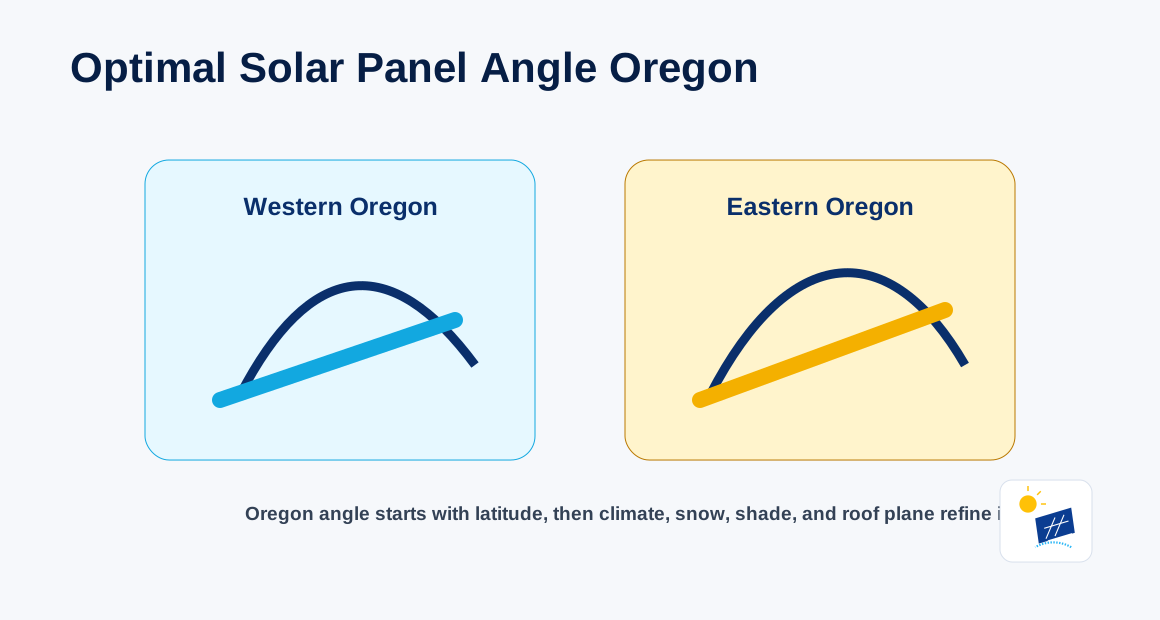
Western and eastern Oregon differ because cloud patterns, tree cover, terrain, snow, and dust change the usefulness of the same latitude angle.
Western Oregon includes the coast, Coast Range, Portland area, Salem, Eugene, and much of the Willamette Valley. The latitude baseline is usually in the mid-40 deg range, but roof shade and winter cloud patterns often matter more than a one-degree tilt difference. Tree cover, hills, dormers, chimneys, and east-west roof planes can decide the usable surface.
Eastern and central Oregon include Bend, Redmond, high-desert communities, mountain areas, and broader open sites. Latitude remains similar in many cities, but snow, dust, wind, and larger ground-mount opportunities can change the practical angle. A ground mount near Bend can follow a latitude target more easily than a shaded roof in Portland.
How does Oregon roof pitch change the angle?
Oregon roof pitch changes the angle because flush-mounted panels follow the roof plane instead of the statewide latitude target.
A Portland-area fixed target near 45 deg does not make a 27 deg roof become 45 deg. A flush-mounted array on that roof uses about 27 deg. The latitude target becomes a comparison value that shows how far the installed roof angle sits from the seasonal or annual target.
Tilt racking can change that panel plane, but racking adds wind exposure, waterproofing details, attachment loads, and access concerns. Coastal wind, mountain snow, and older roofs can make racking less practical. Roof pitch, roof material, and roof condition belong in the Oregon angle decision.
How does Oregon shade change the result?
Oregon shade changes the result because trees, hills, roof obstructions, and neighboring structures can block the sun path before tilt matters.
Willamette Valley and western Oregon properties often have tree shade. Coastal and mountain properties can have horizon constraints. Urban roofs can have chimneys, dormers, vents, and nearby buildings. The best Oregon angle is weaker when the panel surface loses winter or afternoon sun.
Winter shade is especially important because Oregon's winter sun path is lower and shadows are longer. A steep winter target near latitude + 15 deg still needs open sky. Shade mapping by season is more useful than one statewide angle number.
What Oregon examples show the angle range?
Oregon examples show that a statewide result is only a first pass before ZIP code, roof, and shade checks.
An Ashland or Medford site near the low 40s latitude range starts with a fixed tilt in the low 40s, a summer tilt in the high 20s, and a winter tilt in the high 50s. A Portland or Astoria-area site starts closer to the mid-40s, with summer near the low 30s and winter near 60 deg.
A Bend-area property can use a similar latitude target to some western cities, but high-desert dust, snow, wind, and more open land can change the preferred mounting style. A Portland roof can have the same mathematical target and still be limited by tree shade or roof pitch.
How do you calculate Oregon angle accurately?
Calculate Oregon angle accurately by using ZIP code or exact latitude first, then checking roof pitch, azimuth, shade, and mount type.
The calculation order matters. State gives a broad range. ZIP code narrows the location. Exact latitude gives the direct formula input. Roof pitch then decides the installed angle for flush roof mounts. Azimuth decides direction. Shade decides whether sunlight reaches the panel plane.
The Oregon result is an educational planning estimate. PV production estimates require a performance model such as PVWatts or installer software because weather data, losses, array type, and site conditions also shape output.
How do Oregon roof mounts change the angle?
Oregon roof mounts change the angle because flush-mounted panels follow roof pitch. Latitude gives the target, while roof slope, azimuth, shade, and access decide the installed angle.
Oregon roofs can be steep, low-slope, tree-shaded, coastal, valley-facing, or snow-exposed. Roof geometry turns a clean latitude estimate into an installability question.
Roof pitch replaces Oregon latitude when panels are flush-mounted. A 44 deg target and a 30 deg roof create a 14 deg comparison gap. Azimuth then decides compass direction. NREL PVWatts uses azimuth as a separate input from tilt.
Shade can outweigh both tilt and azimuth. Trees, hills, chimneys, dormers, and nearby buildings can block the sun path. A precise Oregon angle on a shaded roof remains limited.
What Oregon angle mistakes matter most?
The main Oregon angle mistakes are using one statewide number, ignoring ZIP code latitude, ignoring roof pitch, ignoring tree shade, and treating angle as a full PV production estimate.
One Oregon statewide angle is incomplete because Ashland, Bend, Eugene, Portland-area cities, and Astoria sit at different latitudes. ZIP code is better than state lookup because it narrows the place before calculating latitude. Exact latitude is better again when the site coordinates are known.
Site review remains necessary because online tools do not see every home-specific variable. DOE guidance states that contractor or installer assessment accounts for site variables that online tools miss.
Use one tool after this page: Calculate My Solar Panel Angle.
Source Notes
- C002, C006: NREL PVWatts V8 documents azimuth and monthly soiling inputs.
- C010-C011: DOE Energy Saver explains site sunlight and assessment limits.
- C013: U.S. Census Gazetteer Oregon place records provide place latitude and longitude.
- C014: Site methodology defines fixed, summer, and winter tilt formulas.
Calculate your solar panel angle
Use the calculator with your location, roof, mount, and orientation context to turn the page answer into a usable planning result.
Calculate Oregon Solar Angle