

What are south facing solar panels?
South facing solar panels are panels with a true-south azimuth, commonly near 180 deg on a compass scale that starts at true north. The term describes direction, not panel tilt.
South-facing direction belongs to azimuth. According to NREL PVWatts documentation, azimuth is a PV input with a valid range from 0 deg to less than 360 deg. In the common convention, 180 deg represents south.
Tilt is separate from south-facing direction. According to NREL PVWatts documentation, tilt is a separate PV input with a 0 deg to 90 deg range. A panel can face south at 15 deg, 30 deg, or 45 deg tilt.
Why does south-facing direction matter?
South-facing direction matters in the Northern Hemisphere because the main fixed-panel sun path sits toward the south. The direction helps a fixed panel face the strongest part of the daily solar arc.
South-facing panels align with the equator-side sun path for Northern Hemisphere sites. The same rule reverses in the Southern Hemisphere, where fixed panels generally face true north. NASA Space Place explains that Earth's tilt creates opposite seasonal patterns between hemispheres.
What does true south mean?
True south means geographic south along Earth's meridians. Solar calculators use true direction because solar position depends on location, date, and time. NOAA Solar Calculator returns solar position values from those inputs.
True south is a measurement reference. A roof that appears south-facing from the street still needs a map bearing or corrected compass reading. The panel surface, not the road, supplies the useful azimuth.
How does south differ from magnetic south?
Magnetic south follows Earth's magnetic field. True south follows geographic direction. A compass reading can differ from true south when local magnetic declination is present.
Solar orientation uses true azimuth. A compass can still help, but the bearing needs correction when the device reports magnetic direction. A map-based roof bearing often gives a cleaner true-direction check.
When is south-facing not the only option?
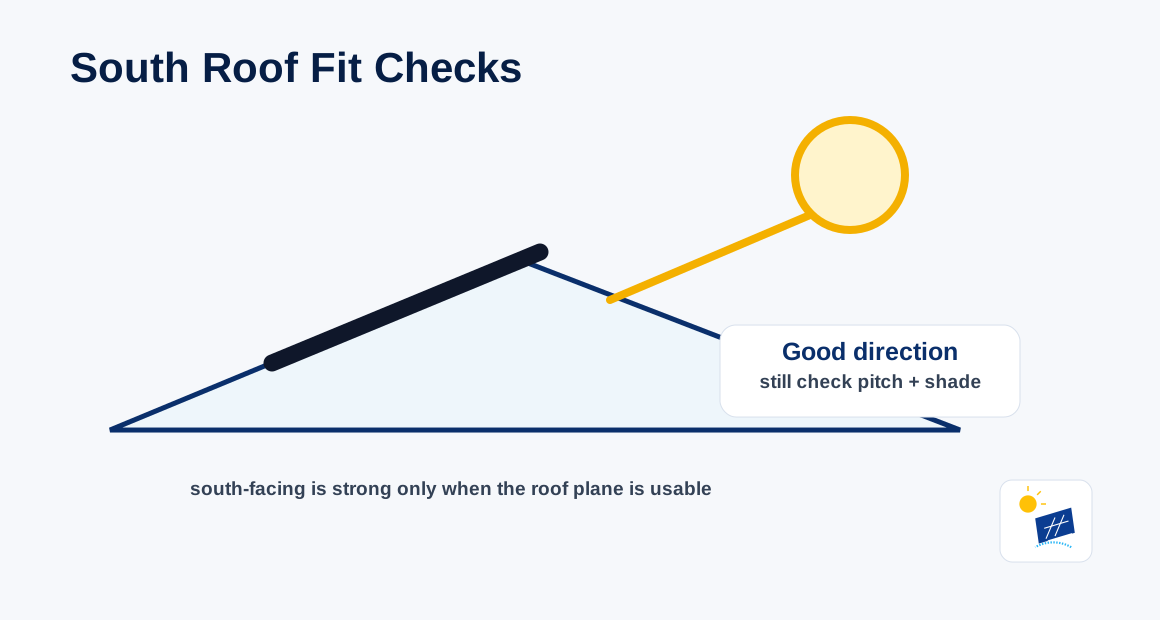
South-facing direction is not the only option when southeast, southwest, east, or west roof planes provide better shade conditions, usable area, safer access, or stronger mounting geometry.
A south-facing roof can be weak when trees, chimneys, dormers, or nearby buildings block the sun path. DOE guidance states that solar planning depends on sunlight reaching the site. A less centered roof plane with clearer sunlight can become the practical surface.
East-facing panels emphasize morning sun. West-facing panels emphasize afternoon sun. Southeast and southwest panels sit between those patterns and true south. The choice belongs to site comparison, not a universal compass rule.
Trackers also change the direction question. According to NREL PVWatts documentation, array types include fixed roof, fixed open rack, 1-axis, 1-axis backtracking, and 2-axis systems. A tracking array moves differently from a static south-facing panel.
When does southeast make sense?
Southeast-facing panels make sense when the morning side of the roof has clearer sunlight, better space, or fewer obstructions than the true-south surface. Southeast is not the same as south, but the surface can still receive useful sun when shade and pitch are favorable.
Southeast also changes timing. The panel receives more morning sunlight than a west-facing surface. A measured azimuth is better than the word southeast because the degree value shows how far the roof sits from true south.
When does southwest make sense?
Southwest-facing panels make sense when the afternoon side of the roof has clearer sunlight, better access, or more usable space. Southwest surfaces often receive more afternoon sunlight than southeast surfaces.
Southwest still needs the same checks as true south. Roof pitch, shade, vents, dormers, and available area can matter more than the label. The usable roof plane is the one with the best combination of true direction, tilt, and sunlight access.
How do roof pitch and shade change south-facing panels?
Roof pitch and shade change south-facing panels because direction alone does not describe the installed panel. Roof pitch sets tilt for flush mounts, and shade controls sunlight access.
Roof pitch sets the panel angle when modules are flush-mounted. A south-facing roof at 22 deg pitch creates a south-facing panel at about 22 deg tilt. A calculated latitude target is still useful, but the roof plane gives the installed slope.
Shade can override direction. A south-facing roof under afternoon tree shade can lose the value of its compass direction. A southwest roof with clearer sky access can be more practical in that case. Site review connects direction with the real sun path.
Soiling and snow also interact with roof pitch. According to NREL PVWatts documentation, soiling can be entered as 12 monthly values that reduce incident solar irradiance. Very low-slope south-facing panels can hold more surface material depending on local weather and roof conditions.
How do you check a south-facing roof?
A south-facing roof is checked by measuring true azimuth, measuring roof pitch, checking shade across the sun path, then comparing the roof plane with calculator and site-review results.
The check has 5 parts:
- Confirm the roof plane selected for panels.
- Measure true azimuth for that roof plane.
- Measure or convert roof pitch to degrees.
- Inspect shade from trees and roof obstructions.
- Compare the result with the orientation calculator.
The south-facing label becomes useful only after measurement. A true azimuth near 180 deg describes direction. Roof pitch describes tilt. Shade describes available sunlight. Mount type describes whether the surface can change. Final installation decisions require site review because online tools do not capture every property-specific variable.
What values belong in the roof check?
A south-facing roof check records 5 values: true azimuth, roof pitch, roof area, shade condition, and obstruction locations. True azimuth tells whether the roof really faces south. Roof pitch tells panel tilt for flush mounts. Shade and obstructions tell whether the surface receives usable sunlight.
The check also records the measurement method. A map bearing, roof plan, or corrected compass reading carries more value than a visual guess. The method matters because small direction errors can enter a calculator as false precision.
What result is ready for a calculator?
A calculator-ready result states direction and slope in degrees. A clean input reads like this: roof plane azimuth 182 deg true, roof pitch 31 deg, shade from chimney in late afternoon, flush mount. That sentence separates direction, tilt, and shade.
The calculator result still remains educational. A south-facing roof can be a strong candidate, but the roof surface, attachment method, electrical path, roof condition, and local rules still need site review.
What examples clarify south-facing panels?
South-facing panel examples clarify the difference between a direction label and a measured solar surface. The useful result combines true azimuth, roof pitch, shade, and mount type.
A roof at 180 deg true azimuth and 34 deg pitch is a clear south-facing candidate in the Northern Hemisphere. The direction and slope are both easy to interpret. The next check is shade from trees, vents, chimneys, and nearby roof planes.
A roof at 160 deg true azimuth is southeast of true south, not exactly south. The surface can still be practical when it has lower shade or more usable area. The degree value gives a better answer than simply calling the roof "south-ish."
A roof at 205 deg true azimuth is southwest of true south. The surface leans toward afternoon sun. The roof can be useful when the true-south face is shaded, too small, or blocked by obstructions.
A roof that faces 180 deg but sits under tree shade is not automatically the strongest surface. South-facing direction is one entity in the decision. Sunlight access, roof pitch, mounting area, and safe access complete the practical answer.
South-facing examples also separate roof language from solar language. A real estate listing can call a roof south-facing, but a solar planner needs true azimuth in degrees. A contractor can describe a roof as good for panels, but the measured result still needs tilt, shade, and usable area. The word "south" starts the check; it does not finish it.
The cleanest south-facing result uses one sentence: roof plane faces 180 deg true azimuth, roof pitch is 30 deg, shade is low, and panels are flush-mounted. That sentence gives direction, slope, sunlight condition, and mount type without mixing entities.
Use one tool after this page: Check Panel Orientation.
Source Notes
- C001-C003: NREL PVWatts V8 documents tilt, azimuth, and array type inputs.
- C006: NREL PVWatts V8 documents monthly soiling inputs.
- C008-C011: NOAA, DOE, and NASA explain solar position, sunlight access, site review, and hemisphere context.
Calculate your solar panel angle
Use the calculator with your location, roof, mount, and orientation context to turn the page answer into a usable planning result.
Check My South-Facing Roof