What does solar panel angle vs efficiency mean?
Solar panel angle vs efficiency means comparing panel geometry with the amount of usable sunlight reaching the module surface.
Panel angle has two geometry parts: tilt and azimuth. PVWatts treats tilt and azimuth as separate inputs. Tilt describes slope from horizontal. Azimuth describes direction from true north.
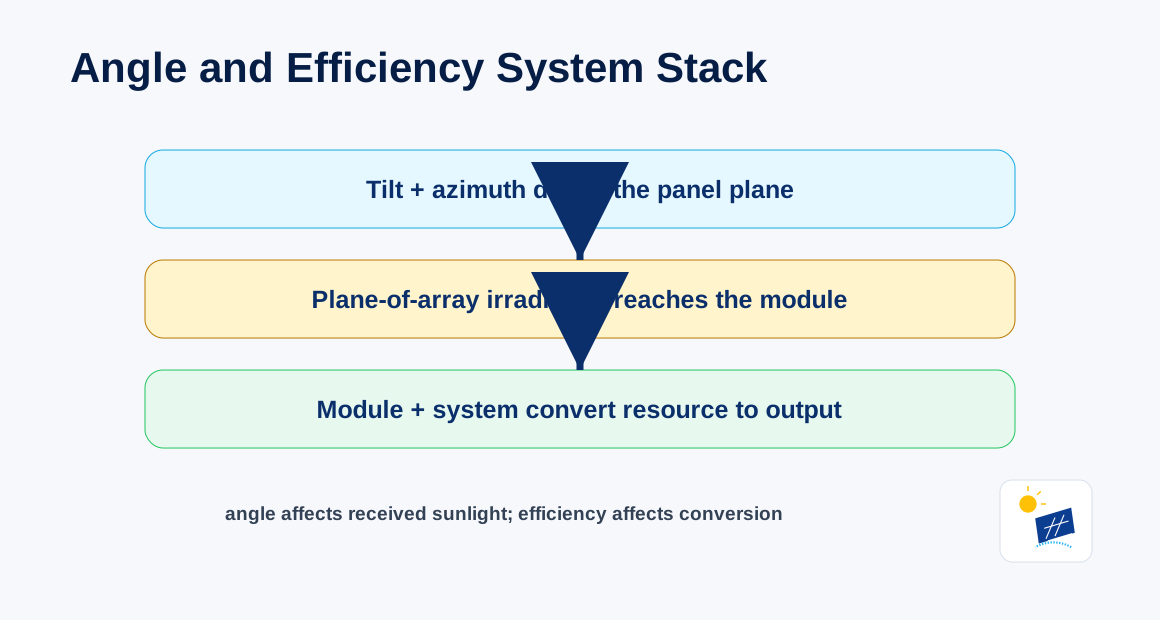
Efficiency belongs to the module and system behavior. PVWatts includes module type, losses, inverter efficiency, temperature output fields, and AC/DC output fields in its modeling structure. Those inputs and outputs show why angle alone is not the same entity as module efficiency.
Does solar panel angle change panel efficiency?
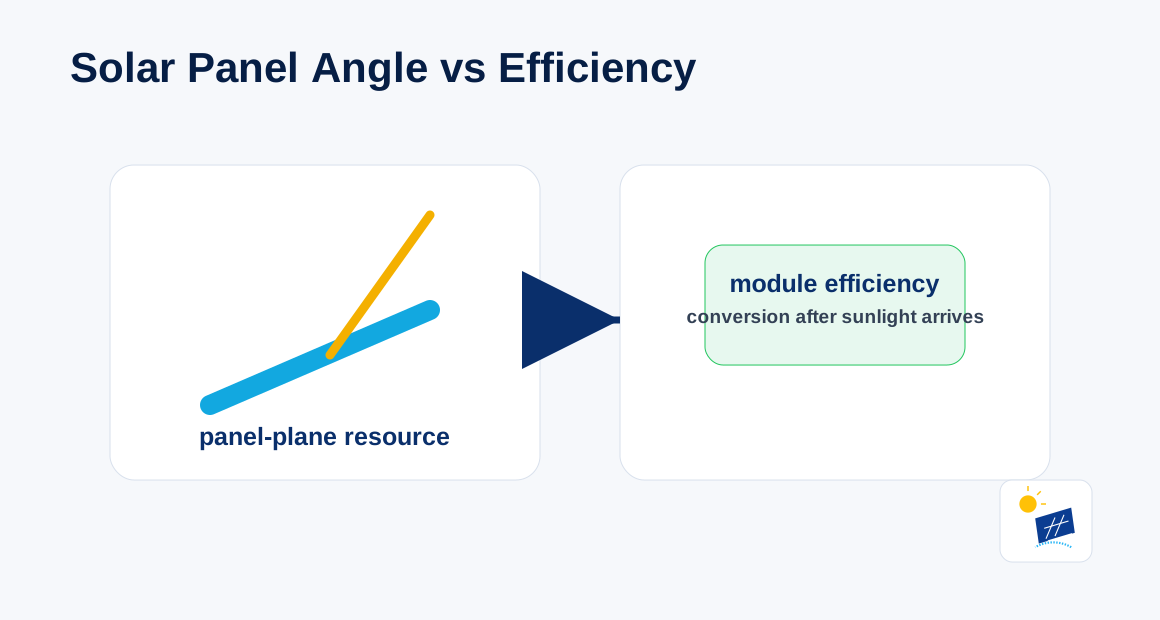
Solar panel angle does not change the rated module efficiency; solar panel angle changes the irradiance available on the panel surface.
Rated efficiency is a module characteristic measured under standard test conditions. Angle changes the real-world sunlight reaching the module plane. A panel at a better angle can receive more plane-of-array irradiance than the same panel at a poor angle.
PVWatts reports monthly and hourly plane-of-array irradiance outputs. That output is closer to the angle relationship than the word efficiency. The panel angle changes the sunlight on the module plane, and the system model then translates that resource through module and loss assumptions.
How does incidence angle connect angle and efficiency?
Incidence angle connects panel angle and usable sunlight by measuring how directly sunlight meets the panel surface.
NREL's Solar Position Algorithm includes incidence-angle calculations for tilted surfaces used in solar radiation applications. A smaller incidence angle means sunlight meets the surface more directly. A larger incidence angle means sunlight reaches the surface at a shallower angle.
Incidence angle depends on sun position and panel surface. Solar zenith and solar azimuth describe the sun. Panel tilt and panel azimuth describe the module. A panel can have a strong tilt and weak azimuth, or a strong azimuth and weak tilt. The combined geometry controls alignment.
How does tilt affect incidence angle?
Tilt affects incidence angle by changing the vertical direction of the panel face. A flatter panel aligns better with higher sun paths. A steeper panel aligns better with lower sun paths. That is why summer tilt is lower and winter tilt is steeper in common seasonal rules.
Tilt alone does not describe the full angle relationship. A 30 deg east-facing panel and a 30 deg south-facing panel have the same tilt but different sun-path alignment. Azimuth must be included before the surface geometry is complete.
How does azimuth affect incidence angle?
Azimuth affects incidence angle by changing whether the panel faces morning, midday, or afternoon sun. In the Northern Hemisphere, true south often aligns fixed panels with the central daily arc. East-facing panels emphasize morning sun. West-facing panels emphasize afternoon sun.
PVWatts uses azimuth as a separate input from tilt. That separation prevents the common mistake of treating "angle" as only slope. Solar performance geometry requires both slope and direction.
How does irradiance connect angle and efficiency?
Irradiance connects angle and efficiency because a panel can only convert the sunlight that reaches its surface.
Plane-of-array irradiance is the solar radiation on the tilted module plane. PVWatts reports monthly plane-of-array irradiance and hourly plane-of-array irradiance when hourly output is selected. That field reflects the orientation of the array surface and the solar resource data.
Global horizontal irradiance describes sunlight on a horizontal surface. A tilted module is not horizontal unless its tilt is 0 deg. The difference between horizontal resource and panel-plane resource is why angle matters. Angle changes the plane that receives sunlight.
What is plane-of-array irradiance?
Plane-of-array irradiance is the irradiance received by the panel plane. The panel plane is defined by tilt and azimuth. A fixed roof array, flat-roof rack, ground rack, and tracker can all have different panel planes.
PVWatts uses weather data, system inputs, tilt, azimuth, and array type to model outputs including plane-of-array irradiance. A calculator that only returns tilt gives geometry context; a performance model adds the irradiance and system layers.
Why does GHI not fully describe panel angle?
Global horizontal irradiance does not fully describe panel angle because GHI is measured or modeled on a horizontal plane. A tilted panel has a different receiving surface. The panel's surface can receive a different mix of direct, diffuse, and reflected light.
This distinction is why performance pages use terms such as plane-of-array irradiance or global tilted irradiance. The tilt and azimuth of the panel define the surface that matters for the module.
How does shade change the angle-efficiency relationship?
Shade changes the angle-efficiency relationship because blocked sunlight cannot be recovered by a better tilt value.
DOE Energy Saver identifies sunlight reaching the site as a solar planning factor. A panel at a strong angle can still lose usable sunlight when trees, chimneys, dormers, parapets, terrain, or nearby buildings block the sun path.
Shade also changes by time. Morning shade affects east-facing panels. Afternoon shade affects west-facing panels. Winter shade often reaches farther because low solar elevation creates longer shadows. Angle selection only works after the panel surface has usable sunlight.
How do soiling and temperature differ from angle?
Soiling and temperature differ from angle because they reduce performance after sunlight reaches the system.
PVWatts includes soiling as a reduction in incident solar irradiance caused by dust or seasonal soiling on the module surface. PVWatts also reports module temperature and ambient temperature in hourly output fields. These are system and condition variables, not panel-angle variables.
The distinction matters for diagnosis. A weak output result can come from poor angle, shade, soiling, temperature, equipment assumptions, or system losses. Angle is only one part of the performance chain.
How do system losses differ from angle losses?
System losses differ from angle losses because losses describe performance reductions after the array geometry has been defined.
PVWatts includes a system losses input and documents loss categories such as soiling, shading, snow, mismatch, wiring, connections, light-induced degradation, nameplate rating, age, and availability. These losses are not the same as tilt or azimuth. They are applied inside a performance model after the system surface and resource context are known.
Angle loss is a geometry comparison. System loss is a performance assumption. Mixing the two creates a vague answer because the user cannot tell whether the issue comes from surface alignment, shade, module conditions, wiring, or model assumptions.
How does tracking change the angle-efficiency relationship?
Tracking changes the angle-efficiency relationship by moving the panel surface instead of keeping one fixed tilt and azimuth.
PVWatts separates fixed open rack, fixed roof mounted, one-axis, one-axis backtracking, and two-axis array types. A fixed array accepts changing incidence angle through the day. A tracker changes its surface to follow the sun path more closely, depending on tracker design.
Tracking does not change module efficiency. Tracking changes the received resource by changing the panel plane over time. The module still converts the irradiance that reaches it according to module and system behavior.
What examples show angle vs efficiency?
Angle-versus-efficiency examples show why geometry and module rating must be separated.
A high-efficiency module on a shaded north-facing roof in the Northern Hemisphere can receive a weak panel-plane resource. A standard-efficiency module on a clear south-facing roof can receive stronger usable sunlight. The module rating is only one layer of the final result.
A second example is tilt mismatch. A panel at 10 deg and a panel at 35 deg can have the same module efficiency rating. The difference is the irradiance received on each panel plane. The performance model converts that irradiance through the same module assumptions.
How much does angle matter compared with module efficiency?
Angle matters by changing solar resource on the panel plane, while module efficiency matters by changing conversion of that received resource.
A high-efficiency module at a weak angle can receive less sunlight than expected. A standard module at a strong angle can receive a stronger plane-of-array resource. The final energy result depends on both the resource reaching the panel and the module/system assumptions.
PVWatts requires module type, system losses, array type, tilt, azimuth, and location inputs. That structure shows the performance relationship clearly: angle is a geometry input, efficiency is one system characteristic, and output comes from the full model.
How do you evaluate solar panel angle vs efficiency?
Evaluate solar panel angle vs efficiency by separating geometry, irradiance, module behavior, and site constraints.
Start with location, tilt, azimuth, mount type, and shade. Then interpret plane-of-array irradiance or use a model that includes it. Next, add module type, losses, soiling, temperature, and inverter assumptions. Avoid reading a poor result as an angle problem until shade and system variables are checked.
The clean practical question is not "does angle change efficiency." The better question is "does this angle give the module a strong panel-plane solar resource." That question keeps the entities in the correct order.
Use one tool after this page: Check Solar Angle Loss.
Source Notes
- C001-C003: NREL PVWatts documents tilt, azimuth, and array type inputs.
- C004: NREL Solar Position Algorithm documents incidence angle for tilted surfaces.
- C005: NREL PVWatts documents plane-of-array irradiance, soiling, temperature, losses, and output fields.
- C009: DOE Energy Saver identifies sunlight access as a solar planning factor.
- C012: Site methodology supports seasonal tilt context.
Calculate your solar panel angle
Use the calculator with your location, roof, mount, and orientation context to turn the page answer into a usable planning result.
Estimate Solar Angle Loss