What does wrong solar panel angle mean?
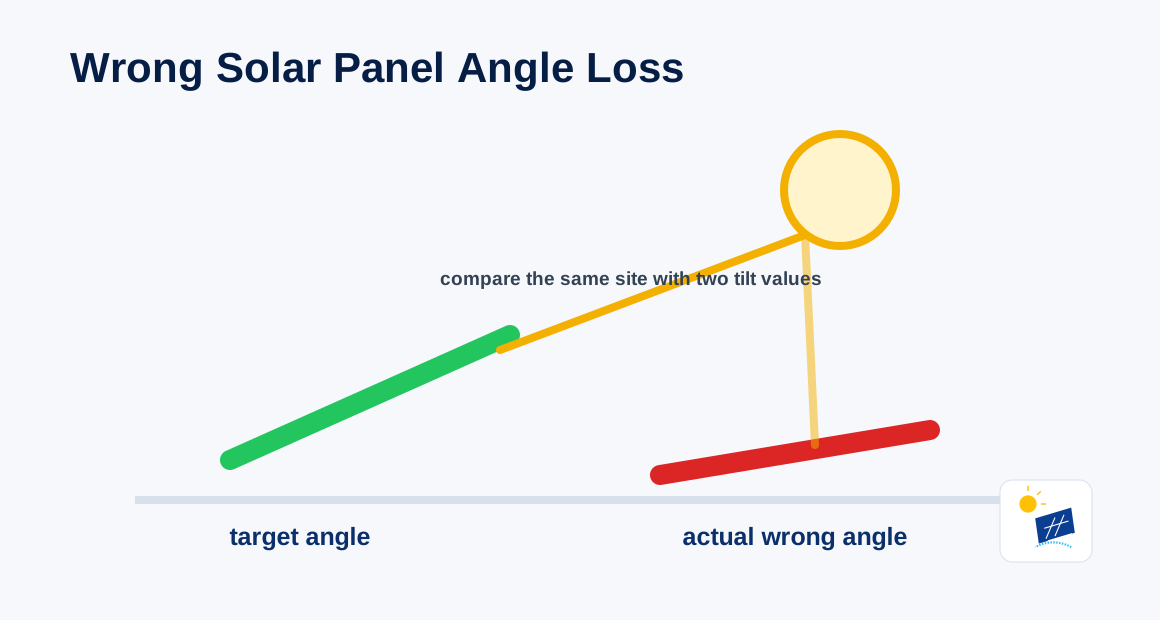
Wrong solar panel angle means the installed panel surface is meaningfully different from the target tilt, target azimuth, or usable sun-path alignment for the site.
The word angle often hides two values. Tilt is slope from horizontal. Azimuth is direction from true north. PVWatts treats tilt and azimuth as separate inputs. A wrong angle can mean wrong tilt, wrong direction, or both.
Wrong angle also depends on the intended use case. A fixed annual array has one target. A winter-biased array has another target. A roof-mounted flush array can be constrained by roof pitch. A ground mount can choose a different surface more freely.
Is efficiency loss the same as energy loss?
Efficiency loss and energy loss are different concepts. Module efficiency is a conversion property, while angle mismatch changes sunlight reaching the panel plane.
A wrong angle does not rewrite the rated module efficiency. A wrong angle changes the irradiance available on the tilted surface. PVWatts reports plane-of-array irradiance values and AC/DC output fields in modeled results. Those outputs are better for estimating angle loss than a generic efficiency percentage.
The user-facing phrase "efficiency lost" usually means "how much output changes." The clean technical interpretation is angle-related energy difference, not module-efficiency change. That distinction prevents overclaiming.
How much loss comes from wrong tilt?
Wrong tilt usually creates a gradual loss curve around the annual target, but the loss grows when the tilt is far from the useful seasonal sun path.
A small tilt error near the annual optimum often has less effect than a large tilt error. The sun path changes throughout the year, so the ideal tilt is not one razor-thin number. A roof pitch slightly above or below the latitude-based target can still be workable.
Large tilt errors matter more. A nearly flat panel in a high-latitude winter can miss lower sun alignment. A very steep panel in high summer can be poorly matched to high sun. Seasonal and monthly comparisons reveal these differences better than one annual number.
How much loss comes from wrong azimuth?
Wrong azimuth can change exposure timing and can create larger losses when the panel faces away from the main sun path.
Azimuth controls direction. In the Northern Hemisphere, true south often aligns fixed panels with the central daily arc. East-facing panels emphasize morning exposure. West-facing panels emphasize afternoon exposure. North-facing panels in the Northern Hemisphere usually represent a stronger constraint.
PVWatts treats azimuth as a separate input because direction changes the modeled array plane. A roof with a good tilt but weak azimuth is not equivalent to a roof with the same tilt and stronger direction. The actual loss depends on latitude, season, horizon, and shade.
How does shade change the loss estimate?
Shade changes the loss estimate because shade can dominate angle mismatch when obstructions block the sun path.
DOE Energy Saver identifies sunlight reaching the site as a solar planning factor. A panel with a good tilt and azimuth can lose exposure under tree shade, chimney shade, parapet shade, or building shade. A less ideal angle on a clear roof can be more practical than a better angle under shade.
Angle loss and shade loss are best separated when possible. First compare angle cases with the same shade assumption. Then evaluate shade as its own site constraint. Mixing both into one number makes the cause harder to interpret.
When does shade matter more than angle?
Shade matters more than angle when the obstruction blocks the panel during its strongest exposure window. Morning shade strongly weakens east-facing panels. Afternoon shade strongly weakens west-facing panels. Midday shade strongly weakens south-facing fixed panels in many Northern Hemisphere sites.
Winter shade is often the strictest condition because low solar elevation creates longer shadows. A winter-focused steep angle cannot recover sunlight blocked by a tree line or nearby building.
When does angle matter more than shade?
Angle matters more than shade when the roof has open exposure and the main variable is surface geometry. A clear roof plane with poor tilt or poor azimuth can be modeled against a better geometry case. Ground mounts and flat roofs often make this comparison easier because racking controls the panel surface.
Even in clear conditions, a performance model is better than a rule-of-thumb percentage. Sun path, weather data, albedo, diffuse light, and system losses all shape the final result.
How do fixed, seasonal, and adjustable angles change loss?
Fixed, seasonal, and adjustable angles change loss by choosing how closely the panel follows seasonal sun height.
Fixed tilt uses one annual setting. Seasonal tilt uses fewer settings, such as spring/fall = latitude, summer = latitude - 15 deg, and winter = latitude + 15 deg. Adjustable or tracking systems can change the panel surface more often when the hardware supports it.
Adjustability reduces geometry mismatch only when the system is adjusted correctly and safely. A roof array that cannot be accessed safely behaves like fixed tilt. A ground rack with clear access can use seasonal changes more realistically.
What example shows angle-loss calculation?
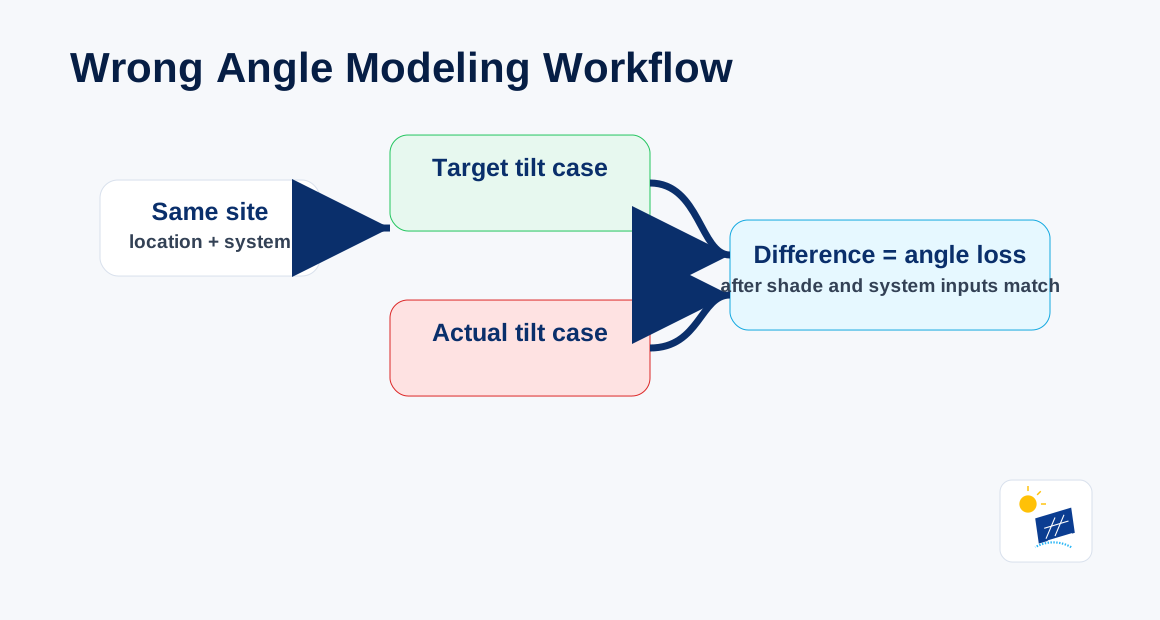
An angle-loss example compares a target case and an actual case with the same location and system assumptions.
If a target case produces 10,000 kWh in a model and the actual-angle case produces 9,500 kWh with all other inputs unchanged, the angle-related difference is 500 kWh. The percentage is 500 divided by 10,000, multiplied by 100. The result is 5 percent for that modeled case.
The same formula can use monthly output. Monthly comparison is useful when the wrong angle mostly hurts winter, summer, morning, or afternoon exposure. Annual comparison can hide those seasonal patterns.
What loss ranges are unsafe to generalize?
Universal loss ranges are unsafe because angle mismatch depends on site geometry, climate data, and the comparison surface.
A small tilt mismatch on a clear roof can produce a modest modeled difference. A strong azimuth mismatch or north-facing constraint in the Northern Hemisphere can produce a much larger modeled difference. A shaded roof can make angle comparison secondary to obstruction loss.
The safest content answer avoids a fixed percentage unless the model inputs are stated. A phrase such as "wrong angle loses 10 percent" lacks latitude, tilt, azimuth, shade, season, weather data, and system context. The controlled comparison method gives a cleaner answer.
How do monthly results reveal wrong angle?
Monthly results reveal wrong angle by showing whether the mismatch appears mainly in winter, summer, or shoulder months.
A panel that is too flat for winter can show weaker winter modeled output than the target case. A panel that is too steep for summer can show weaker high-sun-month alignment. An azimuth mismatch can shift the daily production shape, which is easier to see in hourly data.
PVWatts provides monthly outputs and can provide hourly outputs when configured for hourly timeframe. Those outputs help separate annual average loss from time-specific geometry loss.
What mistakes distort angle-loss estimates?
Angle-loss mistakes include asking for one universal percentage, confusing efficiency with output, ignoring azimuth, and mixing shade with tilt error.
There is no universal loss number for "wrong angle." A 10 deg tilt mismatch in one city is different from a 10 deg mismatch in another city. A south-facing mismatch is different from a north-facing mismatch. A shaded mismatch is different from a clear mismatch.
Another mistake is comparing two systems at once. If one case changes tilt, shade, losses, module type, and inverter assumptions, the result no longer isolates angle. A clean angle-loss estimate changes one variable at a time.
How do you calculate the loss for your site?
Calculate angle loss for a site by modeling the target angle and actual angle with the same system assumptions, then comparing output or plane-of-array irradiance.
Start with location, actual tilt, actual azimuth, target tilt, target azimuth, mount type, and shade notes. Run the target case. Run the actual case. Compare annual output for a broad answer and monthly output for seasonal mismatch.
The result is an educational estimate. PVWatts and similar tools model performance using assumptions and weather data. Final decisions still require site review because roof condition, shade, structural limits, and local installation rules shape the real array.
Use one tool after this page: Check Solar Angle Loss.
Source Notes
- C001-C003: NREL PVWatts documents tilt, azimuth, and array type inputs.
- C005: NREL PVWatts documents plane-of-array irradiance, monthly AC output, hourly output, losses, and system inputs.
- C009: DOE Energy Saver identifies sunlight reaching the site as a planning factor.
- C012: Site methodology supports seasonal tilt baselines.
Calculate your solar panel angle
Use the calculator with your location, roof, mount, and orientation context to turn the page answer into a usable planning result.
Compare Your Angle Loss