What is solar elevation angle?
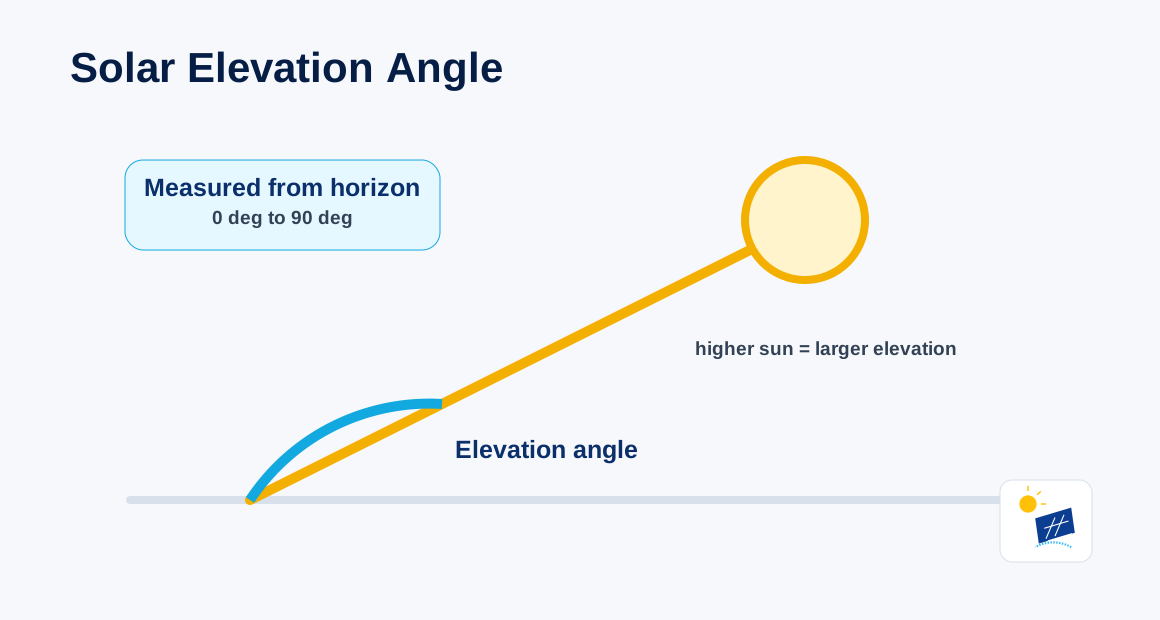
Solar elevation angle is the angle between the sun and the local horizon. It describes the sun's apparent height in the sky at a specific location, date, and time.
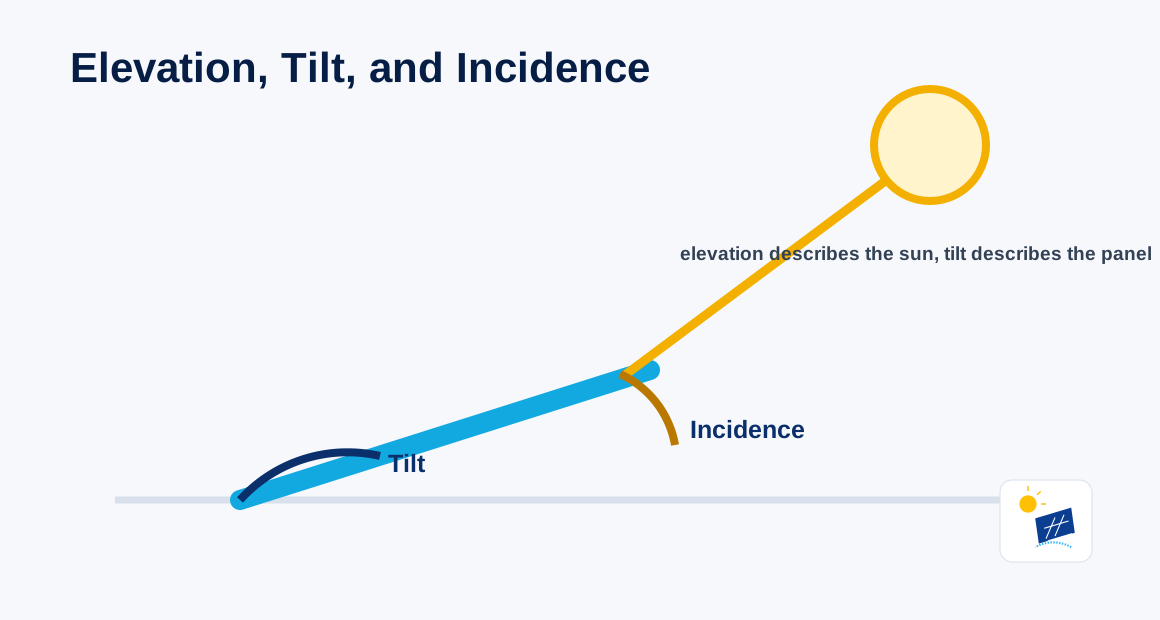
Solar elevation belongs to the sun, not the panel. A panel has tilt. The sun has elevation. Those two angles interact, but they are not the same field in a calculator.
NOAA Solar Calculator returns solar position values based on location, date, and time. NREL's Solar Position Algorithm supports solar radiation applications and includes solar zenith and azimuth calculations, plus incidence angle on tilted surfaces.
For a homeowner, the useful meaning is direct: higher solar elevation creates shorter shadows and a more overhead sun. Lower solar elevation creates longer shadows and a more horizon-side sun. That is why winter shade checks are stricter than summer shade checks.
How is solar elevation measured?
Solar elevation is measured in degrees above the horizon. The horizon is 0 deg, and straight overhead is 90 deg.
A solar elevation value always needs location and time context. The same city has different values at 9 a.m., solar noon, and 4 p.m. The same roof has different values in June and December. The same date creates different values in Miami, Denver, Portland, and Minneapolis.
What does 0 deg mean?
A solar elevation near 0 deg means the sun is near the horizon. Sunrise and sunset occur near that region, with atmospheric and horizon details affecting exact appearances. For solar panels, near-horizon sun usually creates long shadows and weaker direct alignment on many roof surfaces.
Low elevation also makes obstructions more serious. A fence, tree line, chimney, ridge, or nearby building can block light even when it sits far from the panel. The lower the sun, the longer the shadow.
What does high solar elevation mean?
High solar elevation means the sun is high in the sky. In many places, high elevation occurs closer to solar noon and during summer months. Shadows are shorter, and sunlight reaches surfaces from a steeper downward angle.
High elevation does not automatically mean every panel direction is equal. Solar Azimuth and tilt still determine how the panel face aligns with incoming sunlight. A high sun only changes the geometry of that alignment.
How is solar elevation different from solar zenith?
Solar elevation and solar zenith describe the same vertical position from opposite references. Elevation is measured up from the horizon; zenith is measured down from overhead.
The relationship is simple: solar elevation plus solar zenith equals 90 deg. If solar elevation is 25 deg, solar zenith is 65 deg. If solar elevation is 70 deg, solar zenith is 20 deg.
Solar Zenith Angle appears often in technical solar radiation equations because it describes how far the sun sits from the local vertical. Solar elevation appears often in practical planning because it is easier to visualize as height above the horizon.
For solar panels, both values describe the sun. They do not tell the panel tilt by themselves. The panel's own tilt remains a separate surface angle, and PVWatts treats tilt as a separate input with a 0 deg to 90 deg range.
How does solar elevation change through the day?
Solar elevation rises after sunrise, reaches its daily maximum near solar noon, and falls toward sunset.
Morning elevation starts low. Shadows are long, and east-facing surfaces receive the more direct early exposure. Near solar noon, elevation reaches the day's high point. Afternoon elevation falls while the sun moves toward western azimuth values.
This motion explains why checking only midday sunlight is incomplete. An array can look clear near noon and still lose morning or afternoon exposure. A dormer can cast a shadow only during a narrow part of the day. A tree line can matter most when elevation is low.
Solar noon is tied to the local sun, not always the clock. Time zone boundaries, daylight saving time, and longitude shift clock time away from local solar timing. A sun-position calculator handles that translation.
How does solar elevation change by season?
Solar elevation changes by season because Earth's tilt changes the sun's apparent path. Summer has a higher path in many mid-latitude locations; winter has a lower path.
NASA explains that Earth's axial tilt creates seasons by changing how sunlight reaches each hemisphere through the year. For panels, this appears as a higher summer sun and lower winter sun.
How does summer solar elevation affect panels?
Summer solar elevation is higher in many locations. A higher sun often supports a lower seasonal panel tilt because the panel does not have to lean as steeply toward the horizon-side sun. That is why simple seasonal tilt methods often use latitude minus an adjustment for summer.
Summer also shortens many shadows. Obstructions that affect a winter array can appear harmless in summer. That difference is useful, but it can also hide a winter problem if the site is checked only during high-sun months.
How does winter solar elevation affect panels?
Winter solar elevation is lower in many locations. A lower sun supports a steeper seasonal panel tilt in simplified tilt methods because the panel face aligns better with the lower path.
Winter also lengthens shadows. Trees, chimneys, vents, roof ridges, parapets, and nearby buildings become more important. A north-facing roof in the Northern Hemisphere is especially sensitive to winter elevation because it points away from the main low southern arc.
How does solar elevation affect panel tilt?
Solar elevation affects panel tilt because tilt controls how the panel face meets incoming sunlight. Lower sun favors steeper panel angles; higher sun favors lower panel angles.
Panel tilt is measured from horizontal. A flat panel has 0 deg tilt. A vertical panel has 90 deg tilt. PVWatts uses that same 0 deg to 90 deg tilt input.
A simple annual baseline uses a fixed tilt near latitude. A simple seasonal method lowers tilt for summer and raises tilt for winter. Those rules are useful for education and planning, but roof-mounted systems often follow roof pitch because flush mounting keeps the panel close to the roof plane.
The hidden query behind "solar elevation angle explained" is often "what angle do I set my solar panels." Solar elevation helps explain why the answer changes, but it is not the whole answer. The panel angle also depends on latitude, season, Roof Pitch, azimuth, shade, mount type, and whether the array is fixed or adjustable.
How does solar elevation affect shade?
Solar elevation affects shade by changing shadow length. Lower elevation creates longer shadows; higher elevation creates shorter shadows.
Shade is often the most practical reason to understand elevation. A tree south of an array in the Northern Hemisphere can cast a long winter shadow. A chimney can create a moving shadow that crosses one panel row for part of the day. A parapet on a flat roof can shade the nearest row when the sun is low.
Shade also interacts with azimuth. Morning shade arrives from the eastern side of the sun path. Afternoon shade arrives from the western side. Midday shade aligns with the sun's highest daily position. Elevation controls shadow length in all three periods.
DOE Energy Saver planning guidance includes sunlight reaching the site among the solar planning factors. Elevation explains why that sunlight access changes through the day and year.
How do you use solar elevation in planning?
Use solar elevation to understand seasonal tilt, shade risk, and why one roof plane works differently from another.
Start with location and date. Check solar elevation for morning, solar noon, and afternoon. Repeat for summer and winter. Compare those values with roof pitch, panel tilt, roof azimuth, and obstruction locations.
A useful workflow is: find solar elevation, find solar azimuth, measure roof azimuth, measure roof pitch, inspect shade, then model the panel surface. NREL PVWatts accepts location, tilt, azimuth, and array type values for system modeling.
Solar elevation is one of the cleanest ways to understand why a calculator changes answers by season. It turns "best angle" from a memorized rule into a visible sky geometry.
How Does the Sun's Elevation Change Each Month?
The sun's elevation at solar noon shifts every month with the declination cycle, from its June peak to its December low in the Northern Hemisphere. The monthly noon elevation equals 90 degrees minus latitude plus declination, and declination moves through its full plus and minus 23.44 degree range once a year.
The following table shows the noon solar elevation by month for 3 locations.
| Month | Miami 25.8°N | New York 40.7°N | London 51.5°N |
|---|---|---|---|
| Jan | 41.1° | 25.9° | 15.1° |
| Mar | 56.6° | 41.4° | 30.6° |
| Jun | 78.7° | 72.7° | 61.9° |
| Sep | 58.3° | 43.1° | 32.3° |
| Dec | 38.2° | 23.0° | 13.4° |
The monthly pattern drives the seasonal tilt schedule: the months with low noon elevation take the steep winter tilt, and the months with high elevation take the flat summer tilt. The Seasonal Solar Panel Tilt Guide converts this elevation curve into the adjustment calendar.
How Do You Calculate the Solar Elevation Angle for Your Location?
The solar elevation angle is calculated with the formula: noon elevation equals 90 degrees minus latitude plus declination. For Los Angeles at 34 degrees north on the June solstice, declination runs plus 23.44 degrees, so the noon elevation equals 90 minus 34 plus 23.44, which equals 79.4 degrees. On the December solstice the same formula returns 90 minus 34 minus 23.44, which equals 32.6 degrees. The 46.9 degree swing between the two values is why one fixed panel tilt always compromises between seasons.
The Sun Position Calculator returns the elevation for any location and time, and the NOAA Solar Calculator in the sources below computes the same value from any address. The elevation result pairs with the azimuth result to give the full sun position: how high the sun sits and in which direction.
Sources: NOAA Solar Calculator · NASA POWER Solar Data