

Is seasonal angle change useful?
Seasonal angle change is useful for adjustable panels because the sun path sits higher in summer and lower in winter. Fixed roof panels usually use one installed angle instead of seasonal movement.
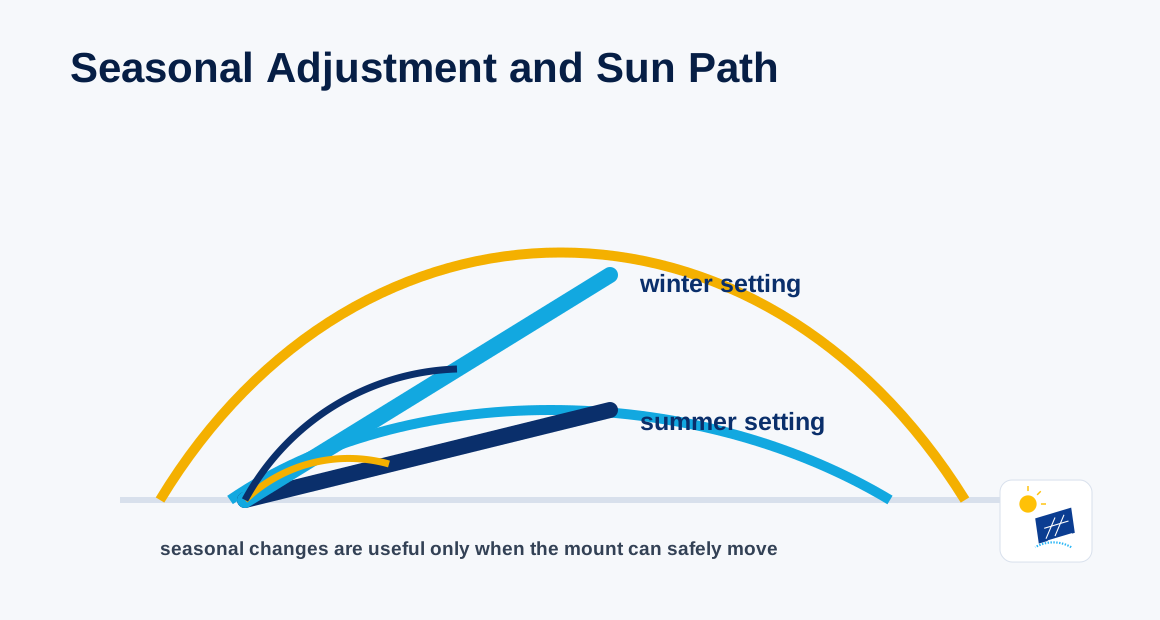
Seasonal tilt changes panel slope to follow the yearly sun-path shift. The panel sits flatter for high summer sun and steeper for low winter sun. NASA Space Place explains that Earth's tilt creates seasonal changes and opposite seasons between hemispheres.
Seasonal adjustment is not a universal requirement. A fixed roof array often stays at the roof pitch. A ground rack can change angle when the structure supports movement. The value comes from matching the adjustment method to the physical array.
Which systems can change angle?
Systems that can change angle include accessible ground mounts, pole mounts, and adjustable racks. Flush roof systems usually stay fixed because the roof plane controls panel tilt.
Mount type decides whether seasonal adjustment is a real option. According to NREL PVWatts documentation, array type categories include fixed open rack, fixed roof mounted, 1-axis, 1-axis backtracking, and 2-axis. These categories separate static arrays from moving arrays.
When do roof panels stay fixed?
Roof panels stay fixed when modules are flush-mounted to the roof plane. A 26 deg roof creates a 26 deg installed panel angle. Seasonal formulas can show the summer and winter targets, but the panel does not move without tilt racking.
Tilt racking changes the roof condition. Raised panels change wind exposure, attachment loads, drainage, appearance, roof access, and row spacing. Final installation decisions require site review because online tools cannot inspect those variables.
When do ground mounts adjust?
Ground mounts adjust when the rack has safe tilt positions and the array can be reached without roof access. Pole mounts and small off-grid arrays often fit this use case better than flush roof arrays. The adjustment still needs hardware strength and safe handling.
Trackers are separate from seasonal manual adjustment. A 1-axis or 2-axis tracker moves by design. Seasonal tilt tables serve fixed and manually adjustable arrays, not tracking algorithms.
What angles fit each season?
Seasonal solar panel angle uses 3 target values: spring and fall equal latitude, summer equals latitude - 15 deg, and winter equals latitude + 15 deg.
The seasonal table gives a clear planning pattern:
| Season | Tilt formula | Example at 40 deg latitude |
|---|---|---|
| Spring | latitude | 40 deg |
| Summer | latitude - 15 deg | 25 deg |
| Fall | latitude | 40 deg |
| Winter | latitude + 15 deg | 55 deg |
Low-latitude summer values stop at 0 deg because negative tilt points past flat. A 10 deg latitude site gives -5 deg from the raw summer formula, but the practical value becomes 0 deg. High-latitude winter values become steep and need wind, access, and snow review.
Hemisphere changes the calendar. Northern Hemisphere summer centers around June and July. Southern Hemisphere summer centers around December and January. The formulas stay the same, but the seasonal months reverse.
Seasonal angle values also depend on the user goal. Spring and fall values support shoulder-season balance. Summer values support high-sun alignment. Winter values support low-sun alignment. A seasonal table without a goal can look complete while hiding the real decision: the user is choosing a maintenance pattern, not only a geometry result.
The fixed value remains the comparison point. A 40 deg latitude site uses 40 deg fixed tilt. The seasonal pattern moves 15 deg below that in summer and 15 deg above that in winter. That 30 deg total spread tells the user whether the mount has enough adjustment range.
What are the tradeoffs?
Seasonal angle changes trade better seasonal alignment for more access, handling, hardware, and site constraints. The gain is practical only when the adjustment is safe and repeatable.
Seasonal tilt is a geometry choice first. The panel face changes position relative to solar elevation. According to NREL Solar Position Algorithm research, solar-position calculations include zenith, azimuth, and incidence-angle relationships for tilted surfaces. Seasonal tilt changes that sunlight-to-surface relationship.
What does access change?
Access changes seasonal adjustment because every angle change requires reaching the array. Roof access adds fall risk and roof-surface risk. Ground access is simpler, but the rack still needs a stable locking mechanism.
Monthly adjustment increases the access burden more than seasonal adjustment. Seasonal adjustment uses a few changes per year. Monthly adjustment uses 12 settings. A low-maintenance site often fits fixed tilt better than repeated changes.
What do wind and snow change?
Wind changes seasonal adjustment because steeper or raised panels can increase exposure. Snow changes seasonal adjustment because steeper winter tilt can improve shedding in some conditions, while access and roof loading still require review. These constraints do not change the formula; they change the usable result.
Soiling also matters at lower angles. According to NREL PVWatts documentation, soiling can be modeled as 12 monthly values that reduce incident solar irradiance. Flatter panels can hold surface material longer, depending on local dust, pollen, leaves, and rain.
How do you decide?
Seasonal angle change fits the site when the mount adjusts safely, the user can reach it, and the seasonal target has practical value after roof pitch, azimuth, and shade checks.
The decision sequence is direct. First, calculate fixed, summer, and winter tilt. Second, identify the mount type. Third, compare the target values with the installed roof pitch or rack range. Fourth, check azimuth. Fifth, inspect shade and access. Sixth, use a model such as PVWatts for performance estimates.
Seasonal adjustment is strongest for accessible adjustable mounts. Fixed tilt is stronger for flush roofs, hard-to-reach arrays, high-wind sites, and owners who want fewer manual changes. Trackers use a different logic because the array moves mechanically across the sun path.
What decision fits a roof array?
A roof array usually stays fixed when panels are flush-mounted. The roof pitch becomes the installed tilt, and seasonal formulas become comparison values. A roof at 30 deg can be compared with spring, summer, and winter targets, but the panel does not change angle unless a rack changes the plane.
The roof decision also includes azimuth and shade. A strong seasonal target loses value on a shaded roof face. A roof with good direction and low shade can be practical even when its pitch differs from the seasonal table.
What decision fits an adjustable array?
An adjustable array fits seasonal changes when the rack has clear locking positions and the user can reach the hardware safely. A 3-setting seasonal routine is simpler than a 12-setting monthly routine. The seasonal routine keeps the main sun-path change without requiring monthly handling.
The final decision is a match between geometry and operation. Seasonal tilt is a strong match when the physical system supports adjustment. Fixed tilt is a strong match when the system is built for low maintenance. Tracking is a separate match when the array type moves automatically.
What examples show the seasonal decision?
Seasonal angle examples show that the same formula produces different decisions for roof arrays, ground mounts, low latitudes, and high latitudes. The mount decides whether the seasonal value becomes usable.
A 40 deg latitude ground mount can use 40 deg in spring and fall, 25 deg in summer, and 55 deg in winter when the rack supports safe movement. The seasonal values are reachable because the array sits on an accessible structure.
A 40 deg latitude flush roof array on a 28 deg roof has a different result. The formula still returns 25 deg for summer and 55 deg for winter, but the installed panel remains near 28 deg. The seasonal values become comparison points rather than movements.
A 12 deg latitude site creates another case. Summer tilt from the raw formula gives -3 deg. The practical summer value becomes 0 deg because the panel cannot tilt below flat without changing its facing side. Low-latitude sites show why tables need physical limits.
A 55 deg latitude site creates the opposite case. Winter tilt reaches about 70 deg. That value is steep enough to require serious wind, snow, access, and rack checks. High-latitude winter values show why seasonal change is a site decision, not only a formula result.
Use one tool after this page: Calculate Your Solar Panel Angle.
Source Notes
- C003: NREL PVWatts V8 documents fixed and tracking array type categories.
- C006: NREL PVWatts V8 documents monthly soiling inputs.
- C007: NREL Solar Position Algorithm connects tilted surfaces with incidence-angle geometry.
- C010-C012: DOE, NASA, and site methodology define site limits and seasonal tilt logic.
Calculate your solar panel angle
Use the calculator with your location, roof, mount, and orientation context to turn the page answer into a usable planning result.
Check My Seasonal Tilt