What is solar irradiance?
Solar irradiance is the solar power received per unit area on a surface, usually expressed in watts per square meter.
Solar irradiance becomes useful for solar panels only after the receiving surface is defined. A horizontal surface receives one irradiance pattern. A tilted panel surface receives another. A tracker changes its surface over time.
PVWatts reports monthly and hourly plane-of-array irradiance values for modeled systems. Plane-of-array irradiance is the irradiance on the panel plane, not only a generic horizontal surface. That field is central to panel-angle interpretation.
How does panel angle affect irradiance?
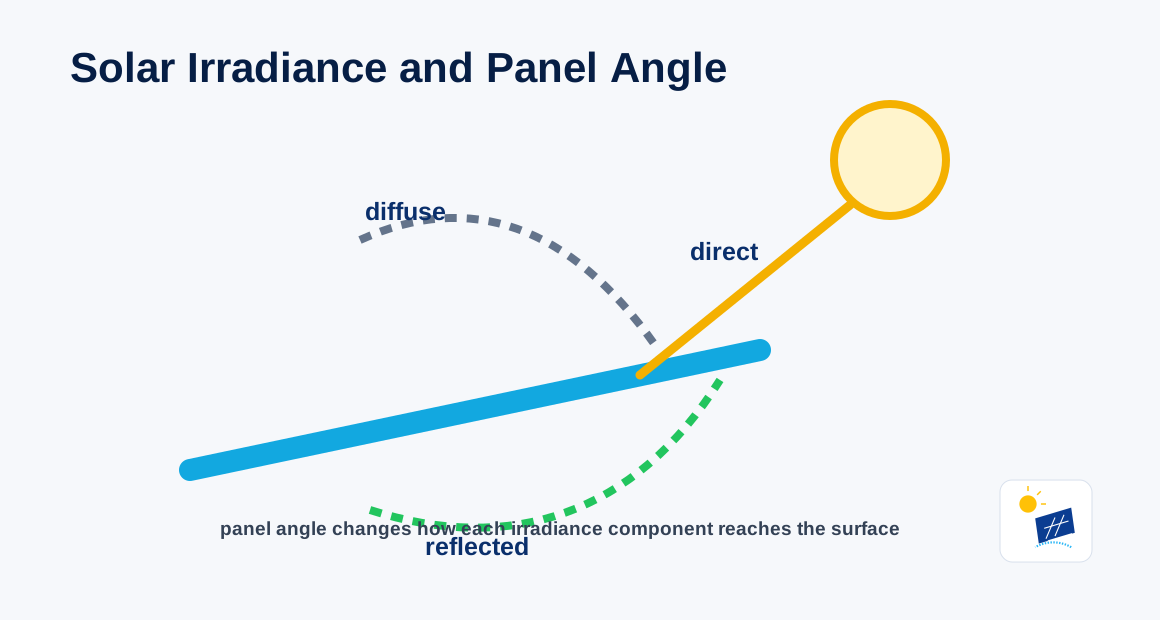
Panel angle affects irradiance by changing the surface that receives direct, diffuse, and reflected sunlight.
Panel tilt changes the vertical slope of the receiving plane. Panel azimuth changes the compass direction of the receiving plane. PVWatts uses both tilt and azimuth as inputs. The combination defines the panel plane.
The same location can produce different panel-plane irradiance when the array is flat, tilted south, tilted east, tilted west, or mounted on a tracker. Angle matters because the receiving surface changes, even when the weather and location stay the same.
What is plane-of-array irradiance?
Plane-of-array irradiance is the irradiance received on the actual tilted panel surface.
The panel plane is defined by tilt and azimuth. A roof-mounted array follows the roof plane when flush-mounted. A flat-roof rack creates its own plane. A ground mount creates a freestanding plane. A tracker creates a moving plane.
PVWatts calls this output `poa_monthly` for monthly plane-of-array irradiance and `poa` for hourly plane-of-array irradiance when hourly output is selected. These fields explain why panel angle affects modeled results.
How does tilt define the panel plane?
Tilt defines the slope of the panel plane from horizontal. A 0 deg panel lies flat. A 90 deg panel is vertical. PVWatts accepts tilt values from 0 deg to 90 deg.
Tilt changes seasonal alignment. Lower tilt aligns more with high sun. Steeper tilt aligns more with low sun. A latitude-based fixed tilt is a common annual baseline, while seasonal settings use lower summer and steeper winter angles.
How does azimuth define the panel plane?
Azimuth defines the direction the panel plane faces. PVWatts accepts azimuth values from 0 deg to less than 360 deg. In the common north-clockwise convention, east is near 90 deg, south is near 180 deg, and west is near 270 deg.
Azimuth changes the timing of direct exposure. East-facing panels emphasize morning sun. West-facing panels emphasize afternoon sun. Equator-facing panels often align with the central daily arc for fixed systems.
How does incidence angle affect irradiance?
Incidence angle affects irradiance because sunlight reaches a surface more directly or more obliquely depending on sun position and panel angle.
NREL's Solar Position Algorithm includes incidence-angle calculations for tilted surfaces. Incidence angle depends on solar zenith, solar azimuth, panel tilt, and panel azimuth. A lower incidence angle means sunlight meets the surface more directly.
Incidence angle is not the only irradiance factor. Diffuse sky radiation, reflected ground light, clouds, air mass, soiling, and weather data also matter. Incidence angle explains the direct-beam geometry, while performance modeling adds the rest of the solar resource.
How do GHI and panel-plane irradiance differ?
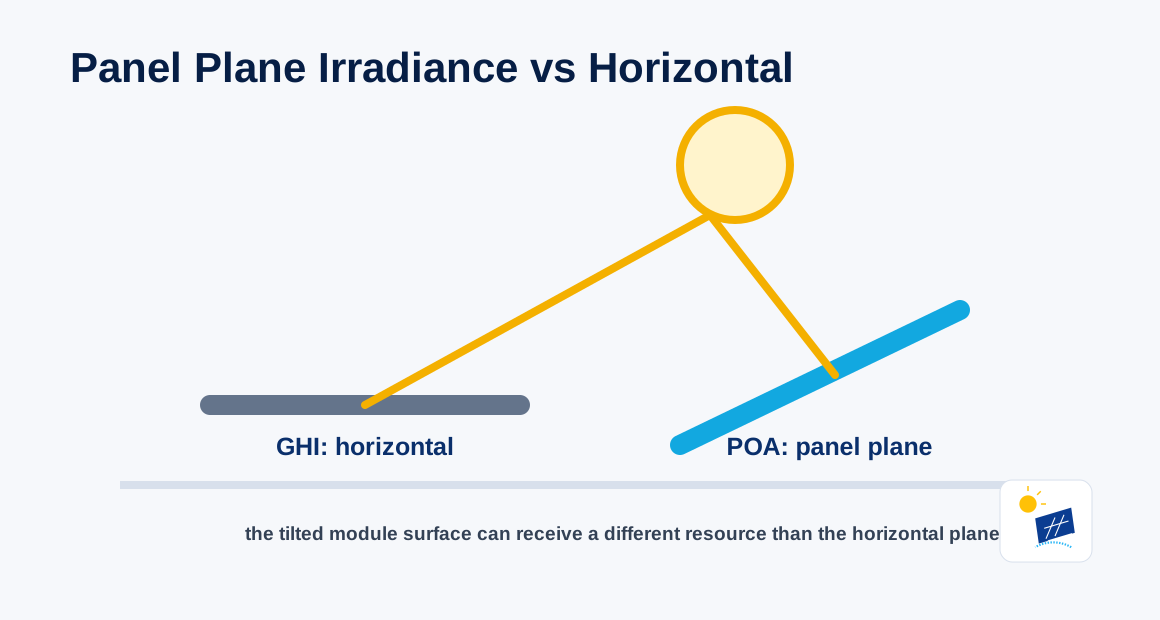
Global horizontal irradiance and panel-plane irradiance differ because GHI belongs to a horizontal surface and plane-of-array irradiance belongs to the module surface.
GHI is useful for describing the solar resource on a flat horizontal plane. A solar panel usually sits on a tilted plane. The tilted plane can receive a different direct, diffuse, and reflected light mix than the horizontal plane.
PVWatts reports plane-of-array irradiance because the module surface is the surface that produces power. A panel-angle calculator gives the geometry. A performance model translates that geometry into panel-plane irradiance and output estimates.
What irradiance components matter for panel angle?
Direct, diffuse, and reflected irradiance components matter because a tilted panel receives sunlight from more than one pathway.
Direct irradiance travels from the sun to the panel in a beam. Diffuse irradiance comes from the sky after scattering. Reflected irradiance comes from the ground or nearby surfaces. A tilted panel changes how these components reach the module plane.
Panel angle mainly changes the geometry of the receiving plane. A steeper panel can face direct winter sun better in some locations, while a flatter panel can fit higher summer sun better. Diffuse and reflected light keep the result from being a simple direct-beam formula only.
How does season change irradiance and panel angle?
Season changes irradiance and panel angle because the sun path changes height and day length through the year.
Summer sun sits higher in many mid-latitude locations, so lower tilt often aligns better with the high seasonal path. Winter sun sits lower, so steeper tilt often aligns better with the low seasonal path. The common seasonal method follows that pattern.
Season also changes shade and weather patterns. Low winter sun creates longer shadows. Cloud and snow patterns vary by climate. A panel-angle decision based on annual averages can miss month-specific irradiance behavior.
How do hourly values improve angle decisions?
Hourly irradiance values improve angle decisions by showing when the panel plane receives more or less sunlight.
Annual totals compress morning, midday, afternoon, summer, and winter into one number. Hourly plane-of-array irradiance shows how the array surface performs through individual time steps. PVWatts can return hourly plane-of-array irradiance when hourly output is selected.
Hourly values are useful for east-west comparisons, shade timing, and tracker analysis. A west-facing roof can look different in afternoon hours than an east-facing roof. A shaded roof can show loss during a specific sun-position window.
How does shade change irradiance on a tilted panel?
Shade changes irradiance on a tilted panel by blocking sunlight before it reaches the panel plane.
DOE Energy Saver identifies sunlight reaching the site as a solar planning factor. A strong tilt and azimuth do not remove shade from trees, buildings, chimneys, vents, dormers, parapets, terrain, or neighboring structures.
Shade also changes by time and season. Low winter sun creates longer shadows. Morning shade affects east-facing surfaces. Afternoon shade affects west-facing surfaces. Shade can dominate the irradiance result when the obstruction blocks the main exposure window.
How do soiling and albedo affect irradiance?
Soiling and albedo affect irradiance after panel angle has defined the receiving surface.
PVWatts includes soiling as a reduction in incident solar irradiance caused by dust or seasonal soiling on the module surface. PVWatts also includes albedo as ground reflectance. These values modify the resource reaching or reflecting toward the array plane.
Soiling is different from tilt, but tilt can influence how debris, dust, leaves, pollen, and snow remain on the glass. Albedo is different from tilt, but tilt and row geometry can change how reflected light reaches the panel surface, especially for bifacial systems.
How does mount type change irradiance?
Mount type changes irradiance because the mount defines whether the panel plane is fixed, roof-following, open-rack, or tracking.
PVWatts separates fixed open rack, fixed roof mounted, one-axis, one-axis backtracking, and two-axis array types. A fixed roof array inherits roof pitch and roof azimuth. An open rack can define its own tilt and azimuth. A tracker changes the surface over time.
Mount type also affects airflow, temperature, row spacing, and shade. Those variables sit outside a simple angle formula, but they shape modeled performance. The irradiance question begins with panel plane and then expands to site design.
How do you use irradiance in panel-angle planning?
Use irradiance in panel-angle planning by comparing how different tilt and azimuth choices change plane-of-array irradiance for the same location.
A clean comparison keeps location, weather dataset, system size, module assumptions, and losses the same. Then it changes tilt or azimuth. The output shows how the panel plane changes irradiance and modeled energy.
This method prevents a common mistake: judging angle only by latitude formulas. Latitude gives a useful starting point. Irradiance modeling shows how the surface interacts with local weather, sun path, and system assumptions.
Use one tool after this page: Check Solar Angle Loss.
Source Notes
- C001-C003: NREL PVWatts documents tilt, azimuth, and array type inputs.
- C004: NREL Solar Position Algorithm documents incidence-angle calculations.
- C005: NREL PVWatts documents plane-of-array irradiance, soiling, albedo, and output fields.
- C009: DOE Energy Saver identifies sunlight access as a solar planning factor.
- C012: Site methodology supports seasonal tilt context.
Calculate your solar panel angle
Use the calculator with your location, roof, mount, and orientation context to turn the page answer into a usable planning result.
Estimate Angle Loss