What is solar panel angle by state?
Solar panel angle by state is a quick reference estimate that assigns each state a representative tilt band. It is faster than ZIP code lookup but less precise than exact latitude.
Solar panel angle is measured from horizontal. NREL PVWatts uses tilt as a PV input from 0 deg to 90 deg. State lookup uses the same angle scale, but it simplifies a state into a broad planning geography.
A state angle estimate does not mean every roof in the state uses one exact angle. Northern and southern parts of the same state can differ by several degrees. ZIP code improves the result by narrowing the location before latitude is calculated.
What are solar panel angles by state?
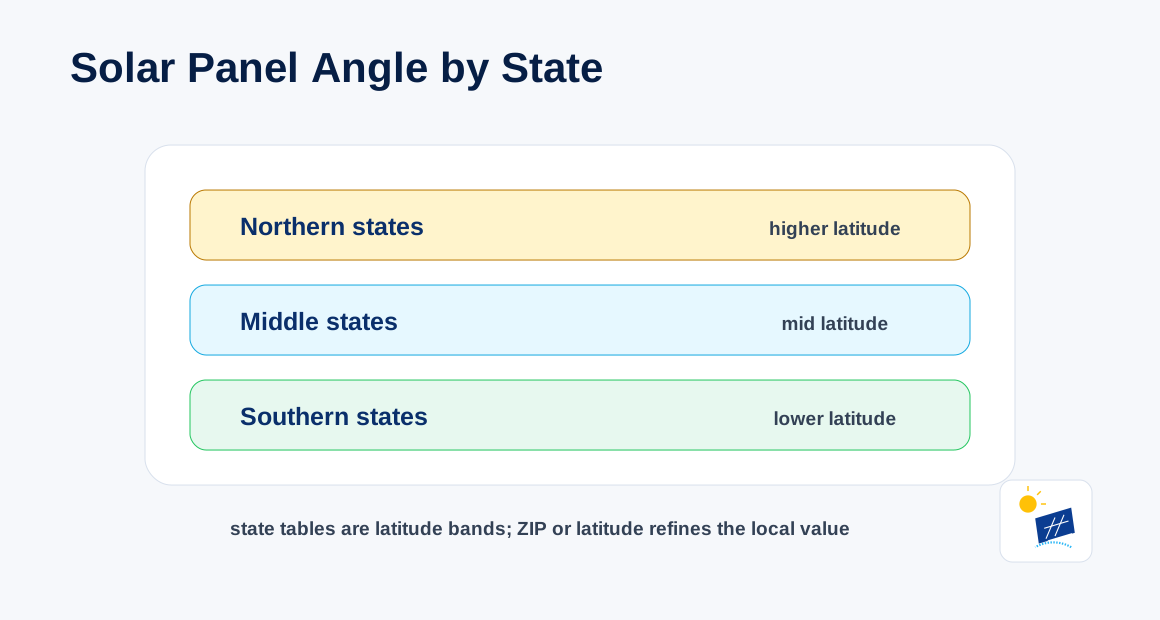
State solar panel angles group the United States into representative fixed-tilt bands. Northern states use steeper baseline angles, middle states use mid-range angles, and southern states use flatter angles.
The table below is a planning index, not a roof-specific result. Seasonal values come from the same baseline: summer = state angle - 15 deg and winter = state angle + 15 deg.
| State group | States | Typical fixed tilt band |
|---|---|---|
| Far north and high-latitude | Alaska, Maine, North Dakota, Montana, Minnesota, Washington, Oregon, Idaho, Vermont, New Hampshire | 43 deg to 60 deg |
| Northern and upper-middle | Wisconsin, Michigan, South Dakota, Wyoming, New York, Massachusetts, Rhode Island, Connecticut, Iowa, Nebraska | 40 deg to 45 deg |
| Middle-latitude | Pennsylvania, Ohio, Indiana, Illinois, Colorado, Utah, Nevada, Kansas, Missouri, Kentucky, Virginia, West Virginia, New Jersey, Delaware, Maryland | 36 deg to 41 deg |
| Lower-middle | California, Tennessee, North Carolina, Oklahoma, Arkansas, New Mexico, Arizona, South Carolina, Georgia, Alabama | 32 deg to 36 deg |
| Southern and low-latitude | Texas, Louisiana, Mississippi, Florida, Hawaii | 20 deg to 32 deg |
This grouping avoids false precision. California, Texas, Florida, Oregon, New York, and Alaska contain large internal variation, so exact ZIP code or latitude lookup gives a better local result.
How do state, ZIP code, and latitude lookup differ?
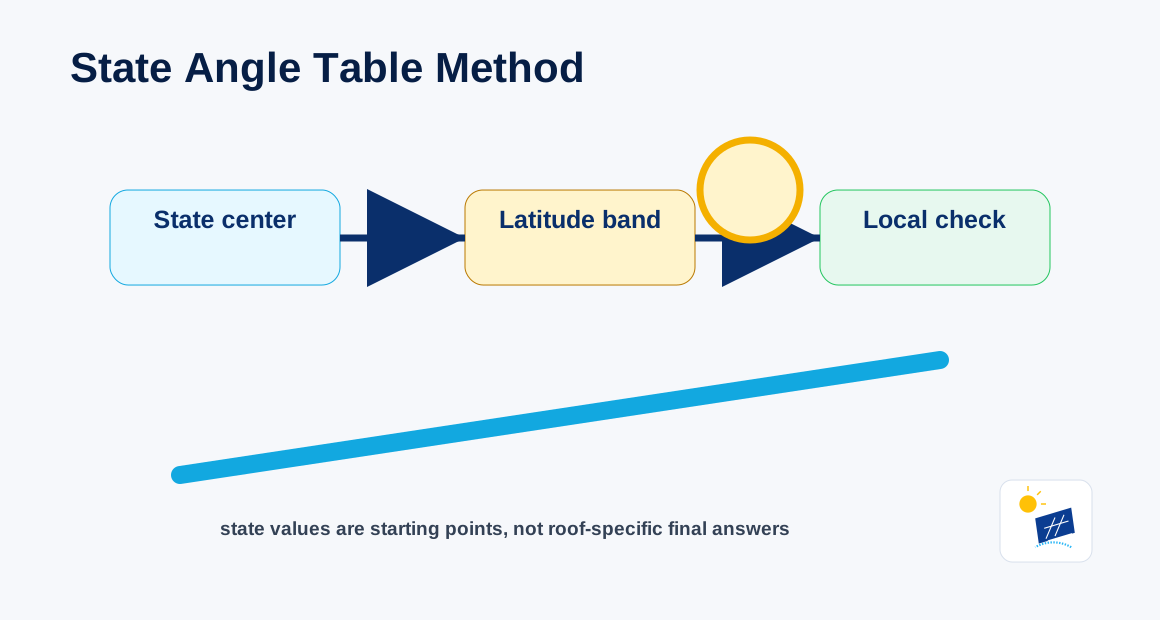
State lookup is broad, ZIP code lookup is local, and latitude lookup is direct. Each step reduces location uncertainty before roof pitch and azimuth checks.
State lookup answers an early planning query. Solar Panel Angle by ZIP Code answers a local query. Latitude lookup answers the mathematical query directly. PVWatts uses latitude and longitude as location inputs, which is why exact location improves the calculation.
State lookup is enough for regional comparison. ZIP code lookup is better for a project location. Exact latitude is best when coordinates, an address-derived location, or a site survey point are available.
How are state angle tables interpreted?
State angle tables are broad planning tools, not exact roof instructions.
A state table compresses many latitudes into one band. That works for quick comparison, but it hides local variation. California spans low-latitude southern cities and higher-latitude northern cities. Texas spans coastal, central, and panhandle regions. Alaska spans a much wider latitude range than any simple table can express.
The correct use is to scan the likely range first. The next step is ZIP code or exact latitude. The final step is Roof Pitch, azimuth, shade, and mount type. A state table is the first layer of the location workflow, not the final answer.
What state examples show the range?
State examples show why large states need local lookup before the angle is used.
Florida and Hawaii usually sit in lower tilt bands than northern states because their latitudes are lower. Oregon, Washington, Maine, Minnesota, and Montana use steeper general ranges because their latitudes are higher. Mid-latitude states such as Colorado, Utah, Illinois, Pennsylvania, and Virginia sit between those groups.
Large states contain internal differences. Northern California differs from Southern California. North Texas differs from South Texas. Western New York differs from downstate coastal areas less than Alaska differs internally, but local lookup still improves precision.
How do roof pitch and azimuth change a state result?
Roof pitch and azimuth change a state result because the state value is only a target tilt band.
Flush-mounted roof panels follow the roof pitch. A state table can suggest a 38 deg fixed tilt, but a 25 deg roof installs near 25 deg unless racking changes the panel plane. The state value becomes a comparison number.
Solar Azimuth decides direction. A roof near the state tilt target can still face east, west, or north. PVWatts separates tilt and azimuth because the panel surface has both slope and compass direction.
How does shade limit state-based angle lookup?
Shade limits state-based angle lookup because a good latitude angle cannot overcome blocked sunlight.
Trees, chimneys, dormers, parapets, hills, and nearby buildings can reduce sunlight on the panel surface. DOE guidance states that solar potential depends on sunlight reaching the site. That condition is local, not state-level.
Winter shade is especially important in northern states because low solar elevation creates longer shadows. Southern states also need shade review when trees, roof obstructions, or nearby buildings block morning or afternoon sun.
How do seasonal state values work?
Seasonal state values use the representative fixed tilt as the baseline, then move flatter in summer and steeper in winter.
If a state band points to a 40 deg fixed estimate, the simplified seasonal targets are about 25 deg for summer and 55 deg for winter. If a state band points to a 30 deg fixed estimate, the simplified seasonal targets are about 15 deg for summer and 45 deg for winter.
Solar Panel Angle by Season is useful for adjustable mounts. A flush roof mount usually stays at roof pitch. A ground mount or pole mount can use seasonal values when the hardware and access support safe adjustment. State values remain broad until ZIP code or exact latitude narrows the result.
How do state angles connect to the calculator workflow?
State angles connect to the calculator workflow as the first location layer before ZIP code, latitude, roof pitch, and azimuth.
The state result gives a range. ZIP code narrows the location. Latitude gives the formula input. Roof pitch gives the installed angle for flush mounts. Azimuth gives direction. Shade confirms whether the panel plane receives the useful sun path.
This workflow prevents false precision. A state table is quick for planning, but a calculator result based on ZIP code or latitude is better for a real roof or ground-mount site.
When is state lookup not enough?
State lookup is not enough when the project location sits in a large state, a mountain region, a coastal region, or a shaded roof site.
Large states can span several useful tilt zones. Mountain and coastal regions can add snow, wind, fog, terrain shade, or roof-access limits. A state value also cannot see roof pitch, roof direction, nearby trees, chimneys, parapets, or buildings.
State lookup works best as a first estimate. A project-ready result comes from ZIP code or exact latitude, followed by roof pitch, azimuth, shade, mount type, and site review.
How do season and mount type change state angles?
Season and mount type change state angles because fixed tilt is only the baseline. Seasonal tilt adjusts the baseline, while roof pitch can override it for flush-mounted panels.
Fixed tilt uses the state angle as a broad annual target. Seasonal tilt subtracts 15 deg in summer and adds 15 deg in winter. Roof pitch overrides state angle when panels sit flush on a roof. A state table can list 40 deg, but a 26 deg roof produces a 26 deg installed tilt unless racking changes the panel plane.
Mount type decides whether seasonal adjustment is practical. Roof mounts usually stay fixed. Adjustable ground mounts can use seasonal or monthly tilt. Trackers use a different moving-array logic.
What mistakes happen with state angle tables?
State angle table mistakes include treating one state value as exact, ignoring ZIP code latitude, ignoring roof pitch, ignoring azimuth, and treating tilt as a PV production estimate.
DOE guidance states that solar potential depends on sunlight reaching the site. Site review remains necessary because online tools miss home-specific variables. A state angle table does not see roof direction, shade, snow, dust, wind, or safe access.
State angle also does not equal production. PV modeling uses tilt, azimuth, location, array type, losses, and weather data. A state angle is a location shortcut, not a performance model.
Sources: NASA POWER Solar Data · NOAA Solar Calculator