
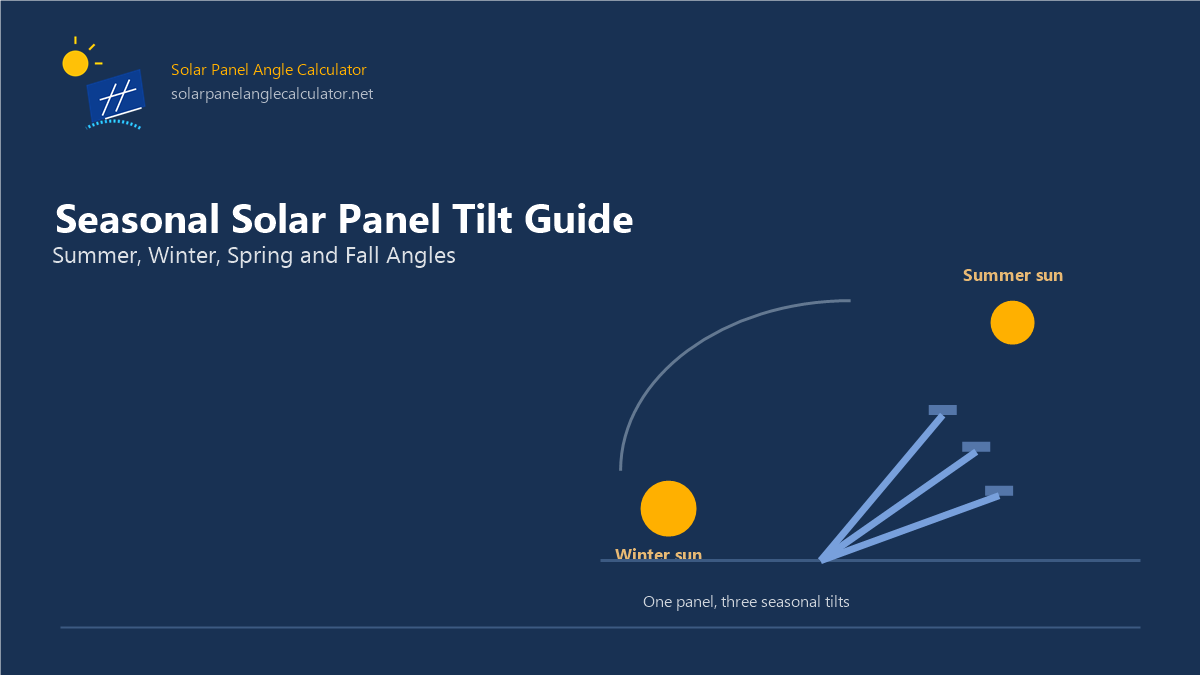
Earth's 23.44-degree axial tilt drives the swing. Solar declination moves from +23.44 degrees at the June solstice to,23.44 degrees at the December solstice, so solar altitude at noon changes every month and the angle of incidence between sunlight and panel surface changes with it. Latitude sets the year-round base, absolute latitude times 0.87, and the seasonal settings shift around that base: summer tilt floored at 5 degrees, winter tilt capped at 65 degrees. The Southern Hemisphere flips the calendar and points panels true north instead of true south.
The adjustment decision follows the mount, not the sun alone. A two-position schedule, flatter near April 1, steeper near October 1, returns 5 to 10 percent more annual energy than a fixed optimum tilt; a four-position quarterly schedule returns 8 to 14 percent. Roof arrays keep a fixed tilt because roof work carries fall risk and the annual yield curve forgives a 10-degree error at 1 to 3 percent loss, while accessible ground mounts, pole mounts, and adjustable racks carry the seasonal or monthly mode safely. The Solar Panel Angle Calculator returns every setting this guide explains: the year-round tilt, the 3 seasonal tilts, and the 12-month table for any city, ZIP code, or coordinates.
What Is Seasonal Solar Panel Tilt?
Seasonal solar panel tilt is the practice of changing a solar panel's tilt angle across the year so the panel surface keeps facing the seasonal sun position. The year-round tilt serves the whole year. The summer tilt flattens that setting to face the higher summer sun. The winter tilt steepens that setting to face the lower winter sun. Spring and fall reuse the year-round tilt because the sun crosses the same mid-path twice a year.
A seasonal tilt system uses 2 angle settings a year. A monthly tilt system uses 12 settings. A fixed tilt system uses 1 setting. These 3 systems, fixed, seasonal, monthly, define the adjustment modes a solar panel angle calculator returns, and every seasonal tilt value in this guide comes from that same calculator engine.
Why Does the Best Solar Panel Angle Change Every Season?
The best solar panel angle changes every season because the sun's noon position shifts 47 degrees between summer and winter, so one fixed panel angle faces the high summer sun or the low winter sun, never both. Earth's axis tilts 23.44 degrees from its orbital plane. This axial tilt moves the solar declination, the angle between the sun's rays and Earth's equatorial plane, from +23.44 degrees at the June solstice to 0 degrees at the equinoxes to,23.44 degrees at the December solstice. Solar exposure and seasonal sun angles follow this declination cycle: the declination of the sun at summer solstice peaks at +23.44 degrees, and the sun angle by month climbs from the December low to the June high in equal monthly steps.
Solar altitude, the sun's height above the horizon, follows directly. At solar noon, solar altitude equals 90 degrees minus latitude plus plus declination. In New York at 40.7 degrees north, the noon sun climbs to 72.7 degrees in June and drops to 25.9 degrees in December, the 47-degree seasonal swing that no fixed angle spans. A panel perpendicular to the noon summer sun sits 47 degrees off the noon winter sun, and the angle of incidence, the angle between incoming sunlight and the panel surface, decides how much solar energy the panel absorbs.
This swing drives seasonal performance variation, not just seasonal angles. A high-latitude array such as London produces a far smaller share of its summer output in December than a Miami array, because the winter sun delivers fewer hours at a lower angle. High-latitude sites gain the most from steep winter tilts and from steeper settings that shed snow; near the equator the seasonal swing shrinks and all four seasons run within a few degrees of flat.
How Much Does the Sun's Angle Shift Each Month?
The sun's noon angle shifts a few degrees every month, which is why a 12-setting monthly schedule tracks the sun tighter than a 2-setting seasonal schedule. The monthly table below shows the sun angles by month, the noon solar altitude for 3 sample latitudes in each month of the year.
The following table shows the noon solar altitude in degrees for each month at 3 latitudes: Miami at 25.8 degrees north, New York at 40.7 degrees north, and London at 51.5 degrees north.
| Month | Miami 25.8°N | New York 40.7°N | London 51.5°N |
|---|---|---|---|
| Jan | 41.1° | 25.9° | 15.1° |
| Feb | 47.9° | 32.7° | 21.9° |
| Mar | 56.6° | 41.4° | 30.6° |
| Apr | 66.1° | 50.9° | 40.1° |
| May | 74.4° | 59.2° | 48.4° |
| Jun | 78.7° | 72.7°* | 61.9° |
| Jul | 75.8° | 62.6° | 51.8° |
| Aug | 67.9° | 52.7° | 41.9° |
| Sep | 58.3° | 43.1° | 32.3° |
| Oct | 48.7° | 33.5° | 22.7° |
| Nov | 41.6° | 26.4° | 15.6° |
| Dec | 38.2° | 23.0° | 13.4° |
*June value reflects the +23.44-degree June solstice declination.
The monthly altitude spread narrows near the equator and widens toward the poles. The Solar Panel Angle by Month page expands this monthly schedule into a full 12-row tilt table with the adjustment workflow.
What Is the Best Solar Panel Angle for Each Season?
The best solar panel angle for each season runs 15 degrees flatter than the year-round tilt in summer, 15 degrees steeper in winter, and equal to the year-round tilt in spring and fall. For a 34-degree year-round tilt, the all-seasons picture reads: 19 degrees in summer, 34 degrees in spring and fall, and 49 degrees in winter. The 30-degree summer-to-winter spread tracks the seasonal sun path: flatter faces the high summer sun, steeper faces the low winter sun.
The calculator derives every seasonal value from the same base: the year-round tilt equals absolute latitude times 0.87, clamped 0 to 90 degrees. Summer tilt equals that value minus 15 degrees, floored at 5 degrees. Winter tilt equals that value plus 15 degrees, capped at 65 degrees. Spring and fall return to the year-round value as the transition-season setting.
What Is the Summer Solar Panel Angle?
The summer solar panel angle is the year-round tilt minus 15 degrees, floored at 5 degrees, used from April through September in the Northern Hemisphere. Summer tilt flattens the array because the summer sun rides high: a 34-degree year-round target in Los Angeles takes a 19-degree summer tilt, and a 45-degree year-round target in London takes a 30-degree summer tilt. The summer angle and the angle summer sun reaches at noon, 72.7 degrees in New York in June, set that flatter geometry together. A flat panel at 0 degrees already faces a near-overhead sun, so the floor at 5 degrees keeps rain washing dust off the surface, a flat panel soils faster and self-cleans worse.
Summer shade timing shifts the practical summer angle. A shallow tilt widens the panel's view of the high sun but lengthens the shadow each row casts on the row behind it, so tightly spaced arrays hold a slightly steeper summer setting than the raw formula returns.
What Is the Winter Solar Panel Angle?
The winter solar panel angle is the year-round tilt plus 15 degrees, capped at 65 degrees, used from October through March in the Northern Hemisphere. Winter tilt steepens the array because the winter sun rides low: a 34-degree year-round target takes a 49-degree winter tilt, and the same array in London runs 60 degrees. The steep winter setting delivers a second winter benefit, snow slides off a steep panel and piles on a shallow one, so a winter angle above roughly 45 degrees sheds snowfall between storms.
Winter azimuth works with winter tilt. The low winter sun spends the whole short day close to south in the Northern Hemisphere, so a winter tilt adjustment returns more energy when the array faces within 20 degrees of true south. Arrays off the equator-facing direction lose more from azimuth error in winter than in summer.
What Are the Spring and Fall Solar Panel Angles?
The spring and fall solar panel angles equal the year-round tilt. Spring and fall mark the transition seasons: the sun crosses the same mid-path in March and September, so the year-round setting, the one angle tuned for the whole year, already faces the shoulder-season sun. An array with a 34-degree year-round tilt runs 34 degrees in spring and 34 degrees in fall, adjusting twice a year: steeper around October 1, flatter around April 1.
The transition dates justify the seasonal schedule's shape. Days shorten from June to December and lengthen from December to June, so the equinox split, summer setting April through September, winter setting October through March, puts the flatter angle where daylight is long and the steeper angle where daylight is short.
How Does Latitude Change Seasonal Solar Panel Tilt?
Latitude changes seasonal solar panel tilt by setting the year-round base the seasonal settings shift around: higher latitudes run steeper angles in every season, and the summer-to-winter spread stays 30 degrees. The Southern Hemisphere mirrors the schedule, the steeper setting lands in its winter and the flatter setting in its summer, and panels face true north there instead of true south.
The following table shows the seasonal solar panel tilt angles for 6 cities spanning 3 latitude zones, with the year-round, summer, and winter settings each city's latitude produces.
| City | Latitude | Year-Round | Summer | Winter |
|---|---|---|---|---|
| Singapore | 1.3°N | 4° | 5° | 19° |
| Miami, FL | 25.8°N | 22° | 7° | 37° |
| Los Angeles, CA | 34.0°N | 33° | 18° | 48° |
| New York, NY | 40.7°N | 35° | 20° | 50° |
| London, UK | 51.5°N | 45° | 30° | 60° |
| Anchorage, AK | 61.2°N | 56° | 41° | 65° |
Three latitude patterns govern the table. First, the summer-to-winter spread holds 30 degrees at every latitude because the 15-degree shift applies to both sides of the base. Second, the spread matters more at high latitude: London's 30-degree swing chases a sun that swings 47 degrees, while Singapore's sun barely moves and all its settings stay nearly flat. Third, the summer floor binds near the equator, Singapore's summer tilt returns the 5-degree minimum, not a negative angle, because a panel does not tilt below horizontal.
The hemisphere rule flips the calendar. Melbourne at 38 degrees south mirrors New York at 40.7 degrees north: a 35-degree year-round tilt, a 20-degree tilt from October through March, and a 50-degree tilt from April through September. The Solar Orientation Calculator converts a roof's compass direction into the azimuth value that pairs with each seasonal tilt.
Should You Change Your Solar Panel Angle Every Season?
Changing your solar panel angle every season returns 5 to 10 percent more annual energy than one fixed optimum tilt on a two-position schedule, and the gain justifies the labor on accessible mounts, not on roof arrays that need a ladder and fall protection. NREL PVWatts simulation data shows a fixed array within 10 degrees of its optimum loses only 1 to 3 percent of annual output, so seasonal adjustment competes against a small loss, and the yield curve forgives owners who adjust late or skip a season.
When Is Seasonal Adjustment Worth It?
Seasonal adjustment pays where the mount moves safely and the energy gain has a use. The 5 clear winners:
- Accessible ground mounts with built-in tilt hinges and angle finders
- Adjustable racks and pole mounts engineered for the steep winter position
- Off-grid systems that must maximize the worst winter month for battery charging
- High-latitude arrays, where the 47-degree sun swing and snow buildup reward the steep winter setting
- Shade-affected sites, where a seasonal rotation dodges a seasonal shadow
When Should You Keep a Fixed Tilt Instead?
A fixed tilt serves 4 situations better than a seasonal schedule:
- Roof arrays, where every adjustment means roof work at the exact tilt and season that carry the highest fall and wind risk
- Mild-latitude sites, where the seasonal spread runs small enough that a fixed angle sits within a few degrees of every seasonal optimum
- Flush roof mounts, where the roof pitch sets the angle and tilt-up racking recovers less energy than it costs
- Hands-off owners, because a skipped adjustment is safe, the yield curve forgives the gap
The Fixed Tilt vs Adjustable Tilt Solar Panels page compares the two mounting systems by hardware cost, maintenance, and adjustment labor for owners deciding at purchase.
How Often Should You Adjust Solar Panels?
Adjust solar panels twice a year on the two-position schedule, flatter around April 1, steeper around October 1, or 4 times a year on the quarterly schedule for 3 to 4 more percent annual gain. Monthly adjustment tracks the sun tightest, but monthly roof or ladder work converts a small energy gain into a recurring chore most owners quit. The cadence decision trades effort for energy at each step.
What Is the Two-Position Adjustment Schedule?
The two-position schedule runs 2 adjustments a year between the seasonal angles. Flatter setting, year-round tilt minus 15 degrees, goes on around April 1. Steeper setting, year-round tilt plus 15 degrees, goes on around October 1. Each adjustment takes minutes on a hinged ground mount, and the schedule returns 5 to 10 percent more annual energy than the fixed optimum tilt for 2 site visits a year.
What Is the Four-Position Adjustment Schedule?
The four-position schedule runs 4 quarterly adjustments: year-round minus 20 degrees near March 1, minus 5 degrees near June 1, plus 10 degrees near September 1, and plus 20 degrees near December 1. The 4-step ladder follows the sun's monthly climb and descent tighter than the 2-step switch and returns 8 to 14 percent annual gain over the fixed optimum, 3 to 4 points more than two-position for 2 extra adjustments.
Is Monthly or Automatic Adjustment Ever Necessary?
Monthly adjustment matters where hardware and demand justify it. Off-grid systems sized around the worst month change angles monthly to flatten the winter production trough, and pole mounts with monthly detents make the work a 10-minute task. Beyond monthly manual work, automatic solar panel angle adjustment becomes tracking: a single-axis tracker follows the sun all day for 20 to 35 percent more annual yield, and the Solar Tracking Angle Calculator sizes that option. A fixed or seasonal array with a sound angle plan reaches within a few percent of the tracker's yield at a fraction of the hardware cost.
Fixed vs Seasonal vs Monthly Tilt: Which Fits Your System?
Fixed tilt fits roof arrays and hands-off owners, seasonal tilt fits adjustable ground and pole mounts, and monthly tilt fits off-grid systems and maintenance-tolerant owners, the same 3 modes every solar panel angle calculator returns. The 3 modes differ in angle count, energy return, adjustment labor, and hardware.
The following table compares the 3 tilt modes across 6 decision attributes: settings, annual energy gain over fixed optimum, adjustments per year, hardware, and the mount type each mode fits.
| Attribute | Fixed | Seasonal | Monthly |
|---|---|---|---|
| Angle settings | 1 | 2 | 12 |
| Annual gain vs fixed | baseline | +5, 10% | +8, 14% |
| Adjustments per year | 0 | 2 | 12 |
| Hardware | any mount | hinged rack, ground, pole | detented pole mount |
| Best mount | roof, flush | adjustable ground | accessible ground, off-grid |
| Record burden | 1 angle | 2 angles + dates | 12-row table |
The mode choice follows the mount. A flush roof mount carries one fixed angle because the roof pitch sets it. An adjustable rack carries the 2 seasonal settings because its hinge spans them. A pole mount with detents carries the monthly schedule because the mechanism makes 12 changes trivial.
Which Tilt Mode Fits Each Mount Type?
- Flush roof mounts: fixed, the roof pitch sets the angle and racking separates panel from roof only at a cost
- Tilt-up roof racks: seasonal, 2 settings recover rack cost where the roof sits far off optimum
- Adjustable ground mounts: seasonal or monthly, hinges and angle finders make either schedule safe from grade level
- Pole mounts: monthly, detents hold each month's angle with a pin, and the mount tolerates the steep winter position
What Limits Seasonal Adjustment on Roofs and Mounts?
Seasonal adjustment on roofs is limited by fall safety, wind and snow load on the steep winter position, and lock hardware, while ground mounts avoid all 3 limits by moving the adjustment to grade level. The steepest seasonal position, the winter tilt, is also the position that catches the most wind and carries the most snow, so an adjustable mount carries its highest structural load at exactly the season a roof visit is least safe. NREL structural guidance for adjustable arrays requires a positive mechanical lock, a pin or bolt, at every position, because wind uplift on a module runs 50 to 100 pounds and a friction-held angle moves.
Roof slope above 20 degrees requires fall protection for any adjustment work, which is why most roof owners run the fixed mode and let the 1-to-3-percent tolerance absorb the seasonal gap. Ground mounts sidestep the limits: their adjustment hinges, angle finders, and in some cases wheels put every seasonal position within safe reach, and the frame, not the roof, carries the winter wind and snow load. The Roof Angle for Solar Panels page details when a roof's own pitch already sits close enough to the seasonal targets, and the Ground Mount Solar Panel Angle page details the ground-frame geometry.
What Seasonal Tilt Mistakes Reduce Production?
The 6 mistakes below each break a link in the seasonal chain, wrong dates, wrong direction, or wrong hardware, and each costs more energy than the adjustment recovers.
- Adjusting on the wrong dates: an October 1 steeper setting installed in January misses the low-sun weeks it exists for
- Mixing hemispheres: copying a Northern Hemisphere schedule in the Southern Hemisphere flattens for the wrong summer and steepens for the wrong winter
- Fixing tilt but not azimuth: the steep winter tilt needs the equator-facing direction; a seasonal tilt on a wrong-facing array amplifies the azimuth error
- Leaving locks loose: wind uplift moves an unpinned panel off its set angle within weeks
- Ignoring row spacing on the steeper setting: a winter tilt lengthens shadows, and the row behind loses the low sun the tilt was chasing
- Copying another city's angles: latitude sets the base, so a Miami schedule on a London array runs 23 degrees shallow all winter
How Do You Calculate Seasonal Angles for Your Location?
Calculate seasonal angles for your location by entering a city, ZIP code, or coordinates into the Solar Panel Angle Calculator, selecting a seasonal or monthly adjustment mode, and reading the summer, spring/fall, and winter tilts from the results dashboard. The calculator returns the year-round tilt from your latitude, shifts it 15 degrees flatter for summer and 15 degrees steeper for winter, and highlights the current month's recommended tilt in the monthly table.
The workflow takes 4 steps:
- Enter your location in the calculator's location field
- Select your mount type and roof details in the installation column
- Choose the adjustment mode, Year-round, Summer, Winter, or Monthly, in the optimization column
- Read the seasonal cards and monthly table, then record the settings your hardware carries
Record-keeping closes the loop. A 2-setting array records 2 angles and 2 dates. A monthly array records the 12-row table the calculator outputs. Every record pairs the tilt with its azimuth, true south in the Northern Hemisphere, true north in the Southern Hemisphere, because the seasonal tilt only performs on the equator-facing direction.
Where to go next:
- Solar Panel Angle Calculator that returns every seasonal angle in this guide for any location
- Solar Panel Angle by Month 12-row monthly tilt schedule behind the seasonal settings
- Solar Orientation Calculator value that pairs with each seasonal tilt
- Fixed Tilt vs Adjustable Tilt Solar Panels decision that decides which seasonal schedule your hardware carries
- Ground Mount Solar Panel Angle adjustment geometry for ground frames
- Roof Angle for Solar Panels a roof's own pitch already sits near the seasonal targets
Seasonal Solar Panel Tilt FAQs
Is the 15-degree seasonal shift correct for every location? The 15-degree shift is the standard seasonal adjustment between 10 and 15 degrees that latitude-based tilt formulas use. High-latitude sites with deep winters run the shift at 15; near-equator sites with a small seasonal sun swing gain little from any shift, and the 5-degree summer floor binds first.
Do seasonal angles matter near the equator? Seasonal angles matter less near the equator. The noon sun swings a few degrees instead of 47, so a 5-to-10-degree fixed tilt serves all seasons, and the summer formula floors at 5 degrees. The tilt's job there is rain self-cleaning, not sun tracking.
Does a steeper winter angle really shed snow? A winter tilt above roughly 45 degrees sheds snow between storms because the panel surface steepens past snow's resting angle. NREL winter-array guidance treats snow shedding as a design benefit of steep winter settings on par with the energy gain at snowy high-latitude sites.
Should azimuth change with the seasons? Azimuth stays fixed through the seasons: true south in the Northern Hemisphere and true north in the Southern Hemisphere serve every tilt setting. The azimuth value pairs with the seasonal tilt; it does not rotate with it. The Solar Orientation Calculator converts any roof direction into its azimuth value.
What happens after adjusting a few weeks late? A late adjustment costs almost nothing. The annual yield curve runs flat within 10 degrees of optimum, a 1-to-3-percent loss band, so a seasonal angle installed a few weeks off its date sits inside the tolerance the whole time.
Do warm climates need winter adjustment? Warm low-latitude climates gain little from winter adjustment because the winter sun stays high and the seasonal spread runs small. Snow-free mild-latitude sites weigh the 5-to-10-percent seasonal gain against 2 ladder visits; snowy high-latitude sites take the winter adjustment for the snow shedding alone.
Sources: US DOE Solar Energy Technologies · NOAA Solar Calculator · NASA POWER Solar Data