
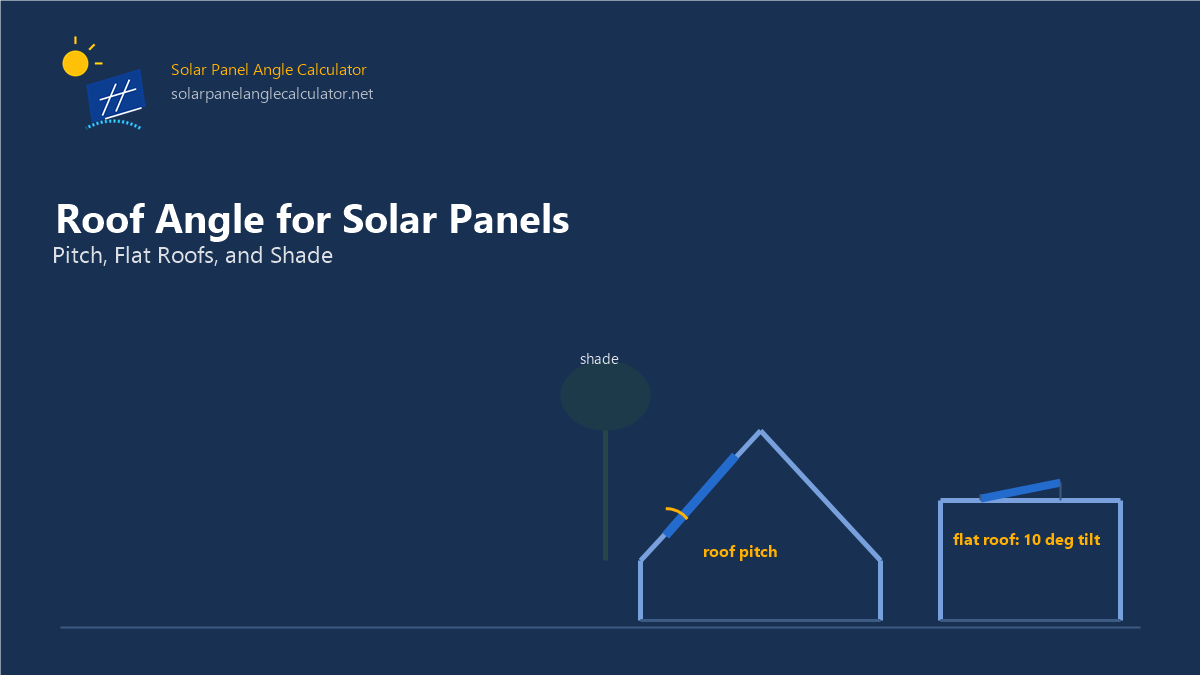
The angle decision runs through three roof situations. A pitched roof supplies the angle: the ideal pitch matches the location's latitude angle, Sydney 34 degrees, Los Angeles 30 to 35, Berlin 45 to 55, and the Clean Energy Council tolerance band forgives everything within 10 to 15 degrees of it. A flat roof chooses its angle by mounting system: ballasted trays at 10 degrees buy self-cleaning, warranty compliance, and row density at a 4 percent energy cost against the latitude tilt. A shaded roof answers to shade first, nothing destroys production like shade, not pitch, not direction, not clouds, measured with a 0-to-100 sun-path survey before any angle math runs.
The Roof Pitch to Solar Angle Calculator converts any pitch into the panel angle, and the Solar Panel Angle Calculator's roof-fit panel compares roof against recommendation live: within 5 degrees, flush mount; 6 to 12, rack review; beyond 12, installer review.
What Is Roof Angle for Solar Panels?
Roof angle for solar panels is the pitch of the plane the panels mount on, measured in degrees from horizontal, and on a flush-mounted array, the roof angle is the panel angle. A roof that rises 6 inches per 12 inches of run, a 6/12 pitch, sits at a 26.6-degree angle. A dead-flat roof sits at 0 degrees, and every mounting decision on it starts from that zero.
Roof angle and solar panel angle are the same number only when panels mount flush. Rack mounting separates the two: the roof holds one angle, the rack holds the panel at another, and the calculator's roof-fit comparison reports the gap between them. A 20-degree roof carrying a rack at 35 degrees runs 15 degrees of separation, the review-band territory this guide returns to throughout.
Three roof situations drive every angle decision: the pitched roof, where the roof supplies the angle; the flat roof, where the mounting system chooses it; and the shaded roof, where shade outranks both. The sections below take each in turn.
What Roof Angle Works for Solar Panels?
The roof angle that works for solar panels sits close to the location's latitude angle, within 10 to 15 degrees of it, the array keeps 98.5 to 99 percent of maximum output, so almost every pitched roof qualifies. The latitude-matching ideal, a roof pitch equal to latitude, exists because panels mounted at the site's latitude angle meet the sun's average position across the year. Sydney at 33.9 degrees south pairs with a 34-degree roof pitch; Los Angeles at 34 degrees north takes 30 to 35; Berlin at 52 degrees north takes 45 to 55.
The following table shows the working roof angle for 6 cities across the latitude range, with the roof pitch that pairs with each location's latitude angle.
| City | Latitude | Ideal roof pitch | Working range (±15°) |
|---|---|---|---|
| Darwin | 12.4°S | 12° | 0, 27° |
| Brisbane | 27.5°S | 27° | 13, 43° |
| Sydney | 33.9°S | 34° | 19, 49° |
| Los Angeles | 34.0°N | 30, 35° | 20, 50° |
| Melbourne | 37.8°S | 38° | 23, 53° |
| Berlin | 52.0°N | 45, 55° | 37, 70° |
The tolerance band comes from Clean Energy Council output data: a Melbourne roof pitched 23 degrees against the 38-degree ideal still generates 98.5 percent of maximum, and a 28-degree pitch generates 99 percent. The flatter the roof, the bigger the gap grows, Melbourne's dead-flat roof generates 86 percent, Brisbane's flat roof 90 percent, and Darwin's 96 percent, because the flat-roof penalty shrinks as latitude drops. Roof-pitch-specific questions, the best pitch by mount and region, have their own page: the Best Roof Pitch for Solar Panels guide carries that query network.
How Does Shade Change the Roof Angle Decision?
Shade changes the roof angle decision by outranking it: nothing destroys solar production like shade, not roof pitch, not roof direction, not clouds, so a shaded roof at the perfect angle generates less than an unshaded roof at a compromised one. A roof mostly shaded from 10 a.m. to 3 p.m. cannot recover through angle choice; the sun window is the resource, and shade closes it. The angle decision on a shaded roof starts after the shade question is answered.
Shade sources divide into two groups with different fixes:
- Fixed roof features, chimneys, flues, plumbing vents, TV aerials, dormers, and parapets, which shade predictably by geometry and season
- Off-roof objects, trees and neighboring buildings, which shade by height, distance, and season, and which change over years as trees grow
Tilt changes shade behavior in both directions. A steeper panel tilts its surface away from low winter shadows cast across the roof plane, but a taller tilt rack lengthens the shadow each row throws on the row behind it, row-on-row shading that a low profile avoids. The shade-versus-tilt tradeoff is why flat-roof systems often accept 10-degree tilts: the low angle packs rows tighter than the shadows they cast.
How Do You Measure Shade Before Choosing an Angle?
Measure shade with a sun-path survey before choosing any angle. A SunEye-class device, or an equivalent smartphone tool with the same geometry engine, photographs the full 360-degree horizon from the roof, locates the site by GPS, and computes the shade percentage for every hour of the year against the sun's position. The output is a single number from 0 to 100: 0 means no shade effect, 100 means no production. No installer quotes a shaded roof without that number, and no angle decision beats a 60 percent shade score, panel-level optimization (microinverters or power optimizers) tolerates partial shade better than string wiring, but it recovers tolerance, not the lost sun.
What Angle Should Solar Panels Be on a Flat Roof?
Solar panels on a flat roof should sit at a 10-degree tilt as the standard, a 5-degree minimum, and a 10-degree warranty floor, because the tilt buys self-cleaning, wind tolerance, and row density, not peak angle. The flat roof removes the roof-pitch constraint and hands the angle decision to the mounting system: ballasted trays at 10 degrees, tilt frames at 15 to 30, or east-west dual-tilt racks at 10 to 15 degrees back-to-back.
The 10-degree standard has three reasons behind it. First, self-cleaning: rain sheets off a 10-degree panel and washes away dust, pollen, and grime, while a panel lying flat pools water at its frame. Second, warranty: many panel manufacturers require a minimum 10-degree mount, and pooled water that seeps past the seal causes an earth fault that kills the module. Third, density: more panels at a low tilt out-produce fewer panels at the latitude angle on the same roof, because every degree of tilt widens the row spacing the layout needs.
Diffuse-light climates run flatter still. Regions with heavy cloud cover and low direct irradiance, coastal belts, high-latitude maritime climates, capture more scattered light at up to 15 degrees less tilt than the latitude rule suggests, which is why a 10-to-20-degree flat-roof array in Scotland outperforms its latitude-titled spec sheet.
Why Do Installers Choose 10 Degrees Over the Optimal Angle?
Installers choose 10 degrees over the latitude-optimal angle because the energy difference is small and the density difference is large. PVWatts data for a 4-kilowatt array at 57 degrees north, Aberdeen, Scotland, yields 2,950 kWh annually at a 10-degree tilt against 3,080 kWh at 35 degrees: a 4 percent gap. The same roof holds more panels at 10 degrees, because a 35-degree tilt throws a shadow several times the row height, while a 10-degree tilt packs rows close enough to double the count. Total roof output favors the dense low-tilt layout.
The gap concentrates in winter. At winter solstice, a real 1,550-watt flat-mounted array peaks near 600 watts while a 900-watt array tilted to 30 degrees peaks near 840 watts, the low sun punishes shallow panels hardest in the short days. Net-metering system owners optimize for annual total and take the low tilt; off-grid owners who must fill batteries in December steepen toward the winter angle instead.
How Do Wind, Ballast, and Drainage Limit Flat-Roof Tilt?
Wind, ballast, and drainage cap the flat-roof tilt below the energy ideal. A tilted panel acts as a sail: wind uplift grows with the tilt angle, so high-wind zones run 5-to-15-degree profiles that present the smallest face to the wind. Ballast weight scales with tilt, every added degree demands more concrete block or heavier frame to hold the array down, and a structural engineer verifies the roof carries the combined load before anything ships. Drainage sets the layout rule: the array never blocks the roof's drainage paths, water flows freely to drains and scuppers, and any roof penetration through the membrane gets professional flashing. Ballasted mounts hold the array down by weight without penetrating the roof; attached mounts bolt through it and trade the ballast for sealed holes. Both work; neither forgives a blocked drain.
How Does Roof Type Change the Angle?
Roof type changes the angle by deciding which planes exist and how the mount attaches: a gable offers two opposite faces, a hip offers four, a shed offers one, and a flat roof offers any angle the mounting system holds. The mount type interacts directly, flush mounts adopt the roof's angle, racks decouple panel angle from roof angle, and ballasted systems engineer their own. Crews mount panels onto the structure the roof provides, and the mounting hardware translates between the two angles when they differ.
The following table shows how four roof types shape the mounting angle.
| Roof type | Usable faces | Angle outcome |
|---|---|---|
| Gable | 2 opposite faces | Panels mount flush at the roof's pitch on the better-facing plane |
| Hip | 4 sloped faces | Two faces carry the array; pitch is fixed, facing is chosen |
| Shed / single slope | 1 face | The building sets both angle and facing; racks compensate |
| Flat | Any orientation | The mounting system sets tilt and azimuth freely |
Steep roofs and low roofs pull the decision in opposite directions. A steep roof beyond the latitude angle sheds snow well but exceeds the summer optimum, flush mounting still wins, because the tolerance band absorbs it. A low roof below the latitude angle sits flat enough to consider tilt-up racking, where a greater tilt on the rack recovers the harvest the roof leaves behind, and the review bands decide: within 5 degrees of the calculated tilt, mount flush; 6 to 12 degrees off, review a rack; more than 12 degrees off, the mounting decision outweighs the angle itself.
How Do Low and Steep Roof Angles Compare?
Low and steep roof angles both work inside the tolerance band: a roof within 15 degrees of the site's ideal keeps 96 percent or more of maximum output, so the comparison is about winter, snow, and racking, not raw production. A low roof, under 20 degrees, holds panels close to horizontal, gains row density, loses winter harvest, and collects snow that a steeper plane would shed. A steep roof, over 40 degrees, holds panels toward the winter optimum, sheds snow freely, and overproduces in winter relative to summer.
The comparison resolves by system goal. Annual-total systems on low roofs accept the flat-roof logic: density beats angle. Winter-heavy and off-grid systems favor the steep plane, where the low winter sun meets the panel closer to perpendicular and snow leaves on its own. Both extremes stay inside the working range of Figure 2's table, Darwin's 12-degree ideal and Berlin's 55-degree ideal both clear 96 percent when the panel matches the roof.
What Roof-Angle Data Belongs in Planning?
Roof-angle planning data covers 6 items: pitch in degrees, facing azimuth, shade score, mount type, row spacing, and structural flags. Each item feeds the calculator or the installer conversation, and a missing item is where angle plans fail.
- Pitch in degrees, the rise/run converted, the number every formula uses
- Facing azimuth, the compass direction of the mounting plane from true north
- Shade score, the 0-to-100 sun-path survey result
- Mount type, flush, rack, ballasted, or attached, which sets who controls the angle
- Row spacing, the shadow-throw distance between rows on low-tilt and flat layouts
- Structural flags, wind zone, snow load, and roof load capacity for ballast or rack review
What Mistakes Distort Roof Angle Decisions?
The 6 mistakes below each break the angle plan at a different joint, the measurement, the shading, or the structure.
- Treating a flat roof as zero-tilt, flat panels void warranties, pool water, and soil over
- Optimizing the angle while ignoring shade, a perfect angle under a shaded window loses to a mediocre angle in the open
- Copying another city's pitch, Darwin's 12 degrees on a Berlin roof wastes half the harvest
- Over-racking a close-fit roof, a 3-degree correction inside the flush band costs more than it returns
- Blocking drainage with the layout, water that cannot reach the scupper finds the membrane instead
- Skipping the structural review, ballast and wind uplift decide the tilt ceiling before energy math does
How Do You Check Roof Angle with the Calculator?
Check roof angle with the Roof Pitch to Solar Angle Calculator, which converts any pitch, degrees or rise/run, into the panel angle and compares it against the calculated optimum; the homepage Solar Panel Angle Calculator's roof-fit panel runs the same comparison live in its results dashboard. Enter the pitch and the roof direction, and the roof-fit output lands in one of three bands: within 5 degrees of the recommended tilt, good fit, mount flush; 6 to 12 degrees off, rack review; more than 12 degrees, installer review.
The workflow takes 4 steps:
- Enter your location so the calculator computes the recommended tilt
- Enter the roof pitch and roof direction in the installation column
- Read the roof-fit result from the results dashboard
- Record the pitch, the azimuth, and the shade score together, the three numbers every mounting decision needs
Roof Angle FAQs
Is 10 degrees really the standard on flat roofs? 10 degrees is the flat-roof standard because it clears the self-cleaning threshold, satisfies the 10-degree warranty minimum on most panels, and keeps rows dense. The energy gap to the latitude angle runs about 4 percent annually at high latitude and less at low latitude.
Can panels sit completely flat? Panels can sit at 0 degrees but should not. Flat panels pool water at the frame edge, void the mounting warranty on most modules, lose self-cleaning, and soil faster. A 5-degree minimum tilt restores drainage; frameless panels partially offset flat-mount problems at higher cost.
Does a steeper roof mean more energy? A steeper roof shifts production toward winter rather than increasing the annual total. Past the latitude angle, each degree trades summer harvest for winter harvest at a small net loss, the annual optimum stays near the latitude-matched pitch.
How much does shade cost compared to angle? Shade costs more than any angle choice. A 50 percent shade score halves usable production; a 15-degree angle error costs 1 to 1.5 percent. No tilt recovers a shaded solar window.
Do east-west flat-roof systems work? East-west dual-tilt systems work as the modern flat-roof alternative: two rows of panels lean back-to-back at 10 to 15 degrees, generating a broad morning-and-afternoon curve that matches household consumption better than a single midday peak. Annual output runs slightly below a south-facing optimum with the same total tilt.
What if my roof pitch matches the latitude but faces west? A west-facing roof at the ideal pitch keeps the angle advantage and shifts production into the afternoon, a timing tradeoff, not a loss. Under time-of-use rates the west face often earns more per kilowatt-hour than a south face at midday.
Sources: US Department of Energy · IEA Solar PV · NOAA Solar Calculator