
The calculation needs 6 inputs before the first formula runs: latitude, hemisphere, season target, roof pitch, mount type, and shade survey. Latitude is the base variable; hemisphere flips the calendar; roof pitch decides whether the computed angle mounts flush or needs a rack. The 15-degree shift traces to solar geometry, Earth's 360-degree orbit over 24 solar hours moves the sun 15 degrees per hour, the angle of the sun at noon swings 46.9 degrees between solstices at 34 degrees latitude, and the declination cycle drives that swing.
Every calculation method in this guide, the 0.87 rule of thumb, the plus-and-minus 15 seasonal set, and the 0.9-latitude precision set, optimizes one goal: solar energy output with the sun's rays striking perpendicular to the panel. The verification band keeps the math honest: a panel within 10 degrees of its calculated optimum loses 1 to 3 percent of annual production throughout the year. The Solar Panel Angle Calculator runs every formula on this page from a city, ZIP code, or coordinates and returns the tilt, azimuth, and 12-month table in one result.
What Do You Need Before Calculating Tilt?
Calculating solar panel tilt needs 6 inputs: latitude, hemisphere, season target, roof pitch, mount type, and shade survey, each one changes the formula's inputs or its output's usefulness. The calculation itself takes seconds once these values sit in front of you; every tilt formula in this guide reads from this list.
The 6 inputs below define the calculation:
- Latitude, the location's distance from the equator in degrees, the base variable every formula uses
- Hemisphere, north or south, which flips the seasonal calendar and the panel direction
- Season target, year-round balance, winter emphasis, or summer emphasis
- Roof pitch, the angle the roof itself supplies when panels mount flush
- Mount type, flush roof, rack, ground, or pole, which decides how much of the calculated angle the hardware can hold; the roof type and mounting system set the physical limit
- Shade survey, trees, buildings, and terrain across the sun path, which can outweigh a perfect number
Latitude comes from any city, ZIP code, or coordinate pair. The Solar Panel Angle Calculator resolves the location and applies every formula in this guide automatically, so the manual method below and the calculator method at the end of this page always return the same numbers.
How Do You Calculate the Year-Round Tilt?
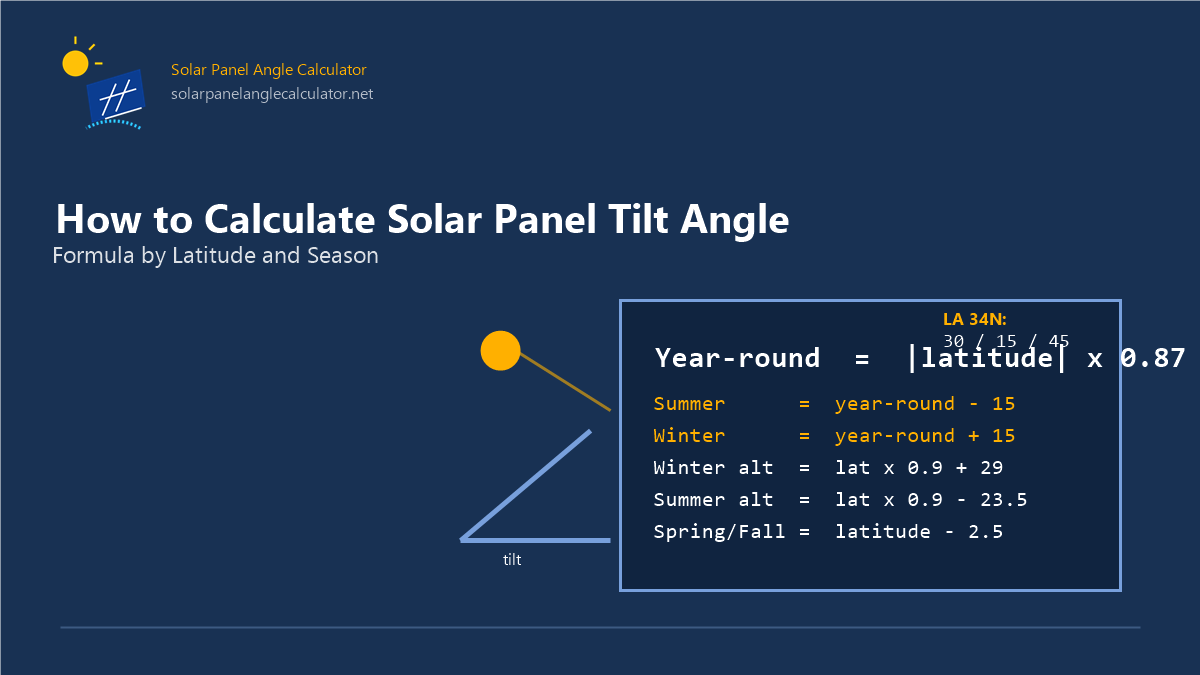
The year-round tilt equals the location's absolute latitude multiplied by 0.87, clamped between 0 and 90 degrees. The 0.87 factor tilts the panel slightly flatter than the raw latitude because summer produces more daylight hours and clearer skies than winter, a small bias toward the stronger season yields more total annual energy production. For Los Angeles at 34 degrees north, the optimal year-round tilt is 34 times 0.87, which rounds to 30 degrees of panel angle from horizontal.
The rule-of-thumb version keeps the same idea memorable: tilt equals latitude. That classic rule runs 1 to 3 percent below the 0.87 optimum at mid latitudes because it leans slightly winter-heavy, but it survives as the starting number most installers quote. Denver at 39.7 degrees north takes a 35-degree year-round tilt by the 0.87 formula and a 40-degree tilt by the raw rule of thumb, both workable, the 0.87 value measurably better. This calculation method is the first formula any solar panel tilt angle calculation runs, and every method below builds on its output.
The clamp keeps the output physical. A latitude of 2 degrees returns a 2-degree tilt, not zero, near-equator arrays stay slightly tilted so rain keeps washing dust off the glass. No formula in this guide returns a negative angle or an angle above 90 degrees.
How Do You Calculate Seasonal Tilt Angles?
Seasonal tilt shifts the year-round value 15 degrees: summer tilt equals latitude-based year-round tilt minus 15 degrees, winter tilt equals that value plus 15 degrees, and the outputs clamp between a 5-degree floor and a 65-degree cap. For a 34-degree latitude: the year-round tilt is 30 degrees, the summer tilt is 15 degrees, and the winter tilt is 45 degrees. The flatter summer angle faces the high sun; the steeper winter angle faces the low sun. This is the tilt angle formula for solar panels that most guides quote as the seasonal calculation.
The hemisphere flips the calendar, not the math. Melbourne at 38 degrees south computes the same three angles as its mirrored northern latitude, 33-degree year-round, 18-degree summer, 48-degree winter, but the summer setting goes on in October and the winter setting in April, because the seasons sit on opposite sides of the calendar.
The adjustment dates follow the equinox split: flatten around April 1 and steepen around October 1 in the Northern Hemisphere, and reverse those dates in the Southern. The winter solstice falls at the middle of the winter season, not the start, which is why the October change date beats the December one, the panel reaches its steep setting before the low-sun weeks arrive.
What Is the 0.9 Latitude Formula?
The 0.9 latitude formula set computes seasonal tilts with a precision multiplier: winter tilt equals latitude times 0.9 plus 29 degrees, summer tilt equals latitude times 0.9 minus 23.5 degrees, and spring/fall tilt equals latitude minus 2.5 degrees. For a 34-degree latitude: winter is 34 times 0.9 plus 29, which is 59.6 degrees; summer is 34 times 0.9 minus 23.5, which is 7.1 degrees; spring and fall sit at 31.5 degrees.
The precision set runs steeper in winter than the plus-15 method, 10 degrees steeper at 34 degrees latitude, because it targets the midday sun on short winter days, when the hours around solar noon carry most of the day's energy. Use the plus-15 method for a general plan and the 0.9 set when a winter-heavy off-grid system must maximize its worst month. Both sets produce valid angles; they optimize for slightly different goals.
How Do You Calculate Monthly Tilt Angles?
Monthly tilt interpolation walks the panel between the summer and winter values in 12 steps, following the hemisphere's monthly sun curve. The Northern Hemisphere runs flat in June, steep in December, and halfway at the equinoxes; the Southern Hemisphere mirrors it. A 34-degree-latitude array with a 15-degree summer floor and a 45-degree winter peak passes through 30-degree angles in March and September on its way between them.
Each month's value comes from the declination curve, not a flat split. The sun's declination moves fastest near the equinoxes and slowest near the solstices, so consecutive monthly tilts change by a few degrees mid-year and hold nearly still in December and June. The full 12-row table for any location is a calculator output: the Solar Panel Angle Calculator prints the monthly schedule with the current month highlighted, and the Seasonal Solar Panel Tilt Guide carries the adjustment workflow that puts those 12 values on real hardware.
How Does Roof Pitch Change the Calculated Tilt?
Roof pitch changes the calculated tilt by replacing it: flush-mounted panels hold the roof's own angle, and the calculation shifts to comparing the roof pitch against the formula's answer. Roof pitch measured as rise over run converts to degrees through the arctangent, a 6/12 pitch rises 6 inches per 12 inches of run, which is a 26.6-degree roof angle.
The comparison runs in three bands:
- Within 5 degrees of the calculated tilt, close fit, mount flush
- 6 to 12 degrees off, rack review, a tilted rack recovers the gap
- More than 12 degrees off, installer review, the mounting decision outweighs the angle itself
A Denver roof at a 30-degree pitch against a 35-degree calculated tilt sits inside the flush band at 5 degrees off. The same roof against a 45-degree winter tilt sits 15 degrees off and needs a rack to hold the winter setting. The Roof Angle for Solar Panels page expands the roof-side geometry, and the Roof Pitch to Solar Angle Calculator converts any pitch directly.
Why Does the Formula Use 15 Degrees?
The 15-degree seasonal shift comes from Earth's orbit: the planet travels 360 degrees around the sun in 24 hours of solar time, so the sun's position moves 15 degrees per hour across the sky, and the seasonal formulas adopt half the practical declination swing as the adjustment step. The underlying driver is solar declination, the angle between the sun's rays and Earth's equatorial plane, which runs from +23.44 degrees at the June solstice through 0 at the equinoxes to,23.44 degrees at the December solstice.
The noon sun altitude follows directly: 90 degrees minus latitude plus plus declination. At 34 degrees north, the midday sun reaches 79.4 degrees in June and 32.6 degrees in December, a 46.9-degree swing. The 15-degree tilt shift tracks about one-third of that swing in each direction because a panel tuned exactly to the solstice sun overshoots the rest of the season; the 15-degree step averages the whole season's path. NREL PVWatts simulations confirm the band: a panel within 10 degrees of its optimum loses 1 to 3 percent of annual output, so the formula needs only to land in the flat zone, not on the exact peak.
What Does the Sun's Position Add to the Calculation?
The sun's position adds the geometry the tilt formula compresses: panels reach peak output when the sun's rays strike perpendicular to the panel surface, and every tilt formula is a shortcut for pointing the panel at the average sun position. To calculate the sun angle precisely, the exact elevation of the sun at any hour, three solar angles formalize that geometry, and each has a dedicated page in this site's solar-position cluster.
The solar zenith angle measures the sun's angular distance from the point directly overhead, 0 degrees at perfect noon overhead, and its formula anchors the position math on the Solar Zenith Angle page. The solar elevation angle is the zenith angle's complement, measuring the sun's height above the horizon, with its formula and calculator on the Solar Elevation Angle page. Solar declination supplies the seasonal term inside the noon-altitude formula, covered on the Solar Declination page, and the solar azimuth angle fixes the horizontal direction the tilt result pairs with on the Solar Azimuth page. The tilt calculation consumes all four as one compressed constant: latitude times 0.87.
How Do You Verify the Tilt Result?
Verify the tilt result with three checks: measure the installed angle with an inclinometer or smartphone app, confirm the direction with a solar-noon shadow, and compare against the tolerance band, a panel within 10 degrees of its calculated optimum loses 1 to 3 percent of annual output, which is the fix-versus-forget line. The inclinometer reads the physical panel angle directly when laid on the frame; a smartphone with a level app does the same job on a flat rail.
The solar-noon shadow verifies direction without instruments: at local solar noon, a vertical pole's shadow points true north in the Northern Hemisphere, and the panel face runs perpendicular to that line. Snow-country arrays add one more verification, a winter tilt at or above 45 degrees sheds snow between storms, so a computed winter angle that also clears 45 degrees passes both checks at once. Angles inside the tolerance band pass; angles outside it move up to the rack review.
What Mistakes Distort Tilt Calculations?
The 6 mistakes below each corrupt a different input, location, hemisphere, or geometry.
- Applying one fixed angle everywhere, a 30-degree tilt in Phoenix and Minneapolis ignores the latitude variable entirely
- Flipping the hemisphere sign, a Southern Hemisphere site run through Northern formulas flattens for the wrong summer
- Reading the compass as true north, magnetic declination bends the azimuth the tilt result depends on
- Copying another city's angle, two cities at similar names differ by latitude; the formula needs the site's own degrees
- Ignoring the clamp, a 10-degree-latitude site returns a negative summer angle, which becomes the 5-degree floor, not a physical minus
- Skipping the shade survey, a shaded perfect angle produces less than an unshaded approximate one
How Do You Calculate Tilt with the Calculator?
Calculate tilt with the Solar Panel Angle Calculator by entering a city, ZIP code, or coordinates, choosing the adjustment mode, and reading the tilt, direction, and azimuth from the results dashboard, the calculator runs the same formulas in this guide without manual arithmetic. The manual method and the tool agree by design: the engine computes the 0.87 year-round value, applies the plus-and-minus 15 seasonal shift, clamps the outputs, and prints the 12-month table. The same tilt angle calculator handles every solar system size, from a single RV panel to a full rooftop solar array.
The workflow takes 4 steps:
- Enter your location in the location field
- Enter the installation details, mount type, roof pitch, roof direction
- Choose the optimization mode, Year-round, Summer, Winter, or Monthly
- Read the recommended tilt with its azimuth, and record both numbers with the date
The record closes the calculation. A tilt written as 30 degrees, azimuth 180 degrees, set October 1 carries everything the next adjustment or installer conversation needs, and the tilt visualization in the results dashboard shows the computed angle against the horizon before anything mounts.
Tilt Calculation FAQs
Is the tilt-equals-latitude rule wrong? The tilt-equals-latitude rule runs 1 to 3 percent below the 0.87-latitude optimum at mid latitudes. It leans slightly winter-heavy, which matters in a 25-year production model and rarely shows on a monthly bill. Off-grid systems that must maximize the worst winter month use it deliberately.
What angle suits a fixed mount that never moves? A fixed mount that never moves takes the year-round 0.87 value, or runs steeper, near the winter angle, when even year-round production matters more than the summer peak. The winter-biased fixed angle trades a few summer kilowatt-hours for a shallower winter trough.
Does the 90-minus-latitude formula work? The 90-minus-latitude formula measures the panel angle from vertical instead of horizontal, so it answers a different question. For a horizontal-referenced tilt, use latitude times 0.87; the vertical-referenced version suits Zenith-style geometry discussions on the solar-position pages.
How do two-season climates handle the formula? Two-season climates, wet and dry, like the Philippines, apply the same latitude formulas with the dry season mapped to summer and the wet season to winter. The declination curve still runs its full annual cycle regardless of local rainfall labels.
What tilt suits east-west facing panels? East-west facing panels keep the latitude-based tilt and split the azimuth: one array faces east, one faces west, each at the same computed angle. The tilt formula does not change with azimuth; the direction result does.
Why do two formulas give different answers? The plus-15 method and the 0.9-latitude set optimize different targets, the first averages the season, the second weights the winter midday. Both land inside the 10-degree tolerance band of each other at most latitudes, and both beat an uncalculated angle.
Sources: US DOE Solar Energy Technologies · NOAA Solar Calculator · NASA POWER Solar Data